The Mistakes Ecommerce Stores Make With Enterprise Security
Your store answers order questions on WhatsApp, Instagram, and Messenger every day. Each of those conversations carries names, addresses, order details, and payment references that attackers treat as valuable. Most ecommerce teams secure the checkout page and leave the chat channels wide open. For a closer look at the options in this space, see Whatsapp Business API.
This article covers five security mistakes ecommerce stores make with customer chat data, fragmented channel tools, missing encryption, compliance gaps in order updates and payments, and platforms chosen without enterprise vetting. You will finish knowing what to check before committing to a communication stack, and how Com.bot builds security into conversational commerce.
Why Ecommerce Stores Underestimate Enterprise Security Risk
Ecommerce teams often prioritize conversion rate optimization and checkout speed while assuming their communication tools are inherently secure. That assumption carries real consequences. Research suggests that a majority of small businesses close within six months of a cyberattack, yet many online retailers treat security as a website problem rather than a business-wide one.
The data flowing through an ecommerce operation is precisely what attackers want. Chat threads, support inboxes, and order confirmations routinely contain personally identifiable information, payment card data, and full order histories. Each of those channels is a potential entry point, not just the storefront itself.
Budgets rarely reflect that reality. Security spending tends to concentrate on the website, the checkout page, and the hosting layer, while messaging platforms, live chat widgets, and social commerce inboxes operate with little oversight. Teams assume the vendor handles everything.
Enterprise security is not just for large corporations. Any store that stores, transmits, or processes customer data faces the same categories of risk as a Fortune 500 retailer, just with fewer resources to absorb a data breach. Recognizing that gap is the first step toward closing it.
The Gap Between Ecommerce Speed and Security Readiness
A typical ecommerce store launches new marketing campaigns and integrates third-party tools within days, but security audits and vulnerability scanning often lag by quarters. A new payment gateway, chat widget, or WhatsApp integration can go live in an afternoon with nothing more than a copy-and-paste snippet.
That speed is a competitive advantage until it is not. A store may adopt a new messaging integration without checking for SQL injection or cross-site scripting protections, and no one notices until an attacker does. Third-party integrations expand the attack surface with every deployment.
Common gaps that go unchecked include:
- Unvalidated input fields in chat or contact forms
- Missing or expired TLS certificates on subdomains
- API endpoints exposed without authentication or rate limiting
- Shared credentials across support and marketing tools
- No logging or monitoring of messages containing customer data
A minimum quarterly security audit gives teams a recurring checkpoint that matches the pace of feature releases. Automated vulnerability scanning adds continuous coverage between those audits, catching misconfigurations and known flaws before they become incidents.
Pair that cadence with basic controls: multi-factor authentication for every admin account, least privilege access for staff, and a documented incident response plan. Speed and security can coexist, but only when security is scheduled rather than postponed.
Mistake 1: Treating Customer Chat Data as Low-Risk
Many ecommerce managers classify chat logs as 'just conversations' rather than regulated data assets that contain PII and payment hints. That single assumption sits behind a long list of security failures.
In reality, a support thread is often the most data-dense record a store holds. It can include a customer's name, home address, order number, phone number, and fragments of payment card data, all stored in plain text on a third-party platform.
Research suggests that a large share of data breaches involve small businesses. Ecommerce teams that treat chat as low-risk tend to skip the controls they apply elsewhere.
- Access control is often loose, with every agent able to read every conversation.
- Encryption may be missing at rest, so archived transcripts sit unprotected.
- Retention rules are rarely defined, so old threads accumulate for years.
Once chat is treated as a regulated data asset, the same standards applied to checkout systems, least privilege, encryption, and audit logging, start to apply to conversations too. That shift reduces both the likelihood and the cost of a breach.
What Gets Exposed in WhatsApp, Messenger, and Instagram Conversations
A single WhatsApp thread can contain a customer's full name, delivery address, phone number, and a screenshot of a credit card used for payment. Messaging platforms were built for speed, not for compliance.
Conversational commerce regularly surfaces several types of sensitive content:
- Order confirmations with order numbers and account details
- Shipping addresses and contact information
- Return requests that include photos of products or receipts
- Payment links and screenshots of card details
Without end-to-end encryption, these messages can be intercepted in transit or accessed through a compromised agent account. A successful phishing attack or credential stuffing attempt against a shared inbox can expose months of conversations at once.
For any payment data shared in chat, tokenization is the safer route. It replaces card numbers with a reference value that has no use outside the payment system. Teams should also apply automatic redaction of sensitive fields, such as card numbers, CVVs, and government IDs, before a transcript is stored or exported.
These steps support PCI DSS compliance and shrink the blast radius of an incident. If a breach does occur, redacted, encrypted records are far less damaging than a raw archive of customer conversations.
Mistake 2: Scattered Channel Security Across Multiple Tools
Using separate tools for WhatsApp, Facebook Messenger, and Instagram DM creates isolated security policies that are hard to enforce consistently. Each platform may bring its own authentication model, logging format, and encryption standard. When those systems operate in silos, security teams lose the single view they need to spot problems early.
This fragmentation is one of the most common ecommerce security oversights. A store might configure multi-factor authentication on one channel and skip it on another, simply because the second tool does not support it or nobody enabled the setting. The result is a patchwork of protections with no shared baseline.
Inconsistent standards also complicate compliance. PCI DSS compliance and privacy rules expect clear controls around customer data and personally identifiable information, yet scattered tools make it difficult to prove who accessed what and when. Auditors want a coherent story, not a dozen disconnected dashboards.
Consider a store that uses Tool A for WhatsApp with MFA enabled, but Tool B for Instagram without MFA. An attacker who compromises the weaker Tool B account may gain a foothold that bypasses the stronger controls entirely. One unprotected channel is enough to undermine the whole setup.
Fragmentation also raises operational costs. Staff must learn multiple interfaces, and access control rules drift apart over time. When someone leaves the company, deprovisioning them across every tool becomes a manual checklist that is easy to get wrong.
Why Fragmented Messaging Platforms Multiply Attack Surface
Every additional messaging platform integration adds another API endpoint, another set of credentials, and another potential entry point for attackers. A busy store may see each integration generate a steady stream of API calls. Multiply that across several channels and the exposed surface grows quickly.
Attackers do not need to defeat every layer. They look for the weakest link, such as a poorly secured third-party integration that was set up in a hurry and never reviewed. Common API vulnerabilities include exposed keys, missing rate limits, and tokens that never expire. Any one of these can open a path into customer data or payment card data.
Fragmented systems also widen the risk of supply chain attacks. Each vendor you connect becomes part of your trust boundary. If that vendor suffers a data breach, your store inherits the consequences even though the failure happened elsewhere.
Consolidating to a unified platform helps enforce consistent security policies across every channel. A single system makes it easier to apply least privilege, centralize security monitoring, and reduce the number of vendor relationships that need scrutiny.
- Fewer integrations mean fewer credentials to rotate and protect.
- Unified logging feeds directly into SIEM tools for faster detection.
- Consistent encryption and TLS certificates apply everywhere at once.
- One incident response plan covers all messaging channels.
Consolidation is not a cure by itself. Stores still need vulnerability scanning, penetration testing, and disciplined patch management. But reducing the number of moving parts makes every one of those tasks more manageable and lowers the odds that a single weak channel becomes the way in.
Mistake 3: Ignoring Encryption in Conversational Commerce
Some ecommerce teams assume that because WhatsApp and Messenger advertise encryption, their entire conversational commerce stack is automatically secure. That assumption creates a dangerous gap. A chat platform may encrypt messages between two users, but the moment a customer taps a web widget, fills out an order form, or hands data to a third-party integration, that protection can disappear.
Conversational commerce rarely lives in one place. A single order might travel from a social messaging app to a website widget, then into a helpdesk tool, a CRM, and a payment processor. Encryption must hold across every one of those hops, not just the first one customers see.
Without TLS certificates and HTTPS on web widgets, data in transit is exposed. An attacker on the same network can intercept names, addresses, order details, and anything else typed into an unsecured form. This is not a theoretical risk. Public Wi-Fi and compromised routers make interception practical for anyone with basic tools.
The core problem is treating encryption as a feature to enable later. It is a baseline requirement, the same way a lock is required on a front door. Teams that defer it are shipping customer data over channels they do not fully control.
End-to-End Encryption as a Baseline, Not a Bonus
End-to-end encryption ensures that only the sender and recipient can read messages, protecting customer data even if a server is compromised. The platform in the middle can route the message, but it cannot read the contents. That distinction matters when a breach exposes a database or an internal system.
Consider a man-in-the-middle attack on a checkout chat. If messages are only encrypted between the customer and the platform, but stored or forwarded in plaintext, an attacker who intercepts that hop can read order details, delivery addresses, and partial payment information. With true E2EE, the same interception yields unreadable ciphertext.
Plaintext storage is the quieter failure. Even when transit is encrypted, some platforms log conversations in readable form for analytics or support review. That turns a single compromised account into a full data exposure, including personally identifiable information that falls under privacy regulations.
Before adopting any conversational platform, verify a few basics:
- Does it offer end-to-end encryption across all supported channels, not just one?
- Are messages stored in plaintext, encrypted at rest, or not stored at all?
- Is the web widget served over HTTPS with a valid TLS certificate?
- Do third-party integrations receive encrypted data or a decrypted copy?
Ask vendors directly and request documentation rather than relying on marketing language. If a provider cannot confirm E2EE coverage or plaintext handling in writing, treat that as a gap. Encryption questions belong in the procurement checklist alongside PCI DSS compliance and access control, not in a post-launch cleanup.
Mistake 4: Overlooking Compliance in Order Updates and Payments
Sending order updates and payment requests via chat may seem convenient, but it can inadvertently violate PCI DSS compliance if card data is transmitted or stored insecurely. Chat threads feel casual, so staff and automated systems often treat them as low-risk channels. That assumption is where ecommerce security breaks down.
Payment card data carries strict handling requirements under PCI DSS. Encryption in transit and at rest, plus tokenization, are baseline expectations rather than optional extras. When a store skips these controls, every order confirmation becomes a potential compliance finding.
Order updates are not exempt just because they avoid card numbers. Messages often bundle names, addresses, phone numbers, and purchase history. That combination qualifies as personally identifiable information under GDPR, CCPA, and similar regional laws.
Teams should treat chat-based order flows with the same scrutiny as checkout pages. A short checklist helps:
- Never request full card details inside a chat conversation, even for verification.
- Use payment links that rely on tokenization instead of raw card entry.
- Confirm which regional data protection laws apply to each customer base.
- Log who can view order threads and restrict access by role.
Compliance failures rarely announce themselves. They surface during audits, after a data breach, or when a regulator opens an inquiry. By then, the cost is measured in fines, remediation, and lost trust.
Where Bulk Messaging and Native Payments Create Hidden Liability
Bulk messaging campaigns that include personalized order details can expose thousands of customer records if the platform lacks proper access control and encryption. One misconfigured audience segment can push the wrong order data to the wrong recipients.
Bulk messaging APIs are often rate-limited but not audited. Rate limits govern volume, not behavior. Without audit logs, a store cannot prove who accessed customer data, when, or why. That gap matters during incident response and regulatory review.
Native payment features inside messaging platforms introduce a separate risk. Some store card tokens without undergoing PCI DSS validation. A token is only as safe as the environment holding it.
Stores evaluating a platform should look for specific signals:
- Tokenization that keeps raw card numbers out of chat and databases.
- Audit logs capturing access, exports, and configuration changes.
- Published compliance certifications covering payments and data handling.
- Encryption using current TLS certificates for all message traffic.
- Role-based access control aligned with least privilege principles.
Sending payment requests through unsecured chat channels compounds every one of these problems. If the channel is not built for regulated data, the request should not travel through it.
These risks connect directly to broader enterprise security failures. API vulnerabilities in messaging integrations, weak third-party integrations, and unmonitored access all feed the same exposure. Regular security audits, penetration testing, and vulnerability scanning help surface gaps before attackers do.
An incident response plan should cover messaging and payment channels, not just the main storefront. Security monitoring and SIEM tooling can flag unusual message volume, odd export activity, or failed authentication attempts. Multi-factor authentication on every admin account closes an easy entry point for credential stuffing and phishing attacks.
The underlying lesson is simple. Convenience cannot override compliance. A platform chosen for speed must still meet the same bar as any system touching payment card data or personal information.
Mistake 5: Choosing Communication Tools Without Enterprise-Grade Vetting
Selecting a communication tool based on features and price alone, without a security vetting process, is a recipe for a future breach. Team chat platforms, help desk inboxes, and customer messaging apps often hold order details, shipping addresses, and fragments of personally identifiable information. When those tools are weak, they become an easy doorway into your broader systems.
Most ecommerce teams adopt these tools the same way they adopt a project tracker: sign up, invite the team, connect a few integrations. That speed feels productive, but it skips the questions that matter. Does the vendor encrypt stored messages? Who can export conversation history? What happens if their systems are compromised?
Enterprise-grade vetting starts with recognized certifications. SOC 2 Type II shows an independent auditor reviewed the vendor's controls over time, not just on a single day. ISO 27001 signals a formal information security management system. If the tool touches payment card data in any way, PCI DSS compliance belongs on the list too.
Certifications alone are not enough. Ask for recent penetration testing reports, ideally summarized for customers under NDA. Confirm that multi-factor authentication is available for every user, and that role-based access control lets you limit who sees what. A support agent should not have the same visibility as a finance lead.
Two areas get overlooked most often. First, the incident response plan: how does the vendor detect, contain, and notify customers after a breach? Second, data residency: where is your customer data stored, and does that location satisfy your legal obligations? A tool that stores European customer messages on servers outside the region can create compliance problems long before any attacker shows up.
Communication platforms also expand your attack surface through third-party integrations. Every connected app inherits some level of trust. A single weak integration can open the door to supply chain attacks or expose API vulnerabilities you never assessed. Vetting the platform means vetting what connects to it.
What to Check Before Committing to a Platform
Before signing a contract, ask for the platform's most recent penetration test results, its incident response plan, and a list of subprocessors. These three items reveal more about real security posture than any marketing page. Use the checklist below as a working framework, and treat missing answers as red flags rather than minor gaps.
- Encryption at rest and in transit, with current TLS certificates on every endpoint.
- Multi-factor authentication enforced for all users, including admins.
- Role-based access control aligned with least privilege principles.
- Audit logs that record logins, exports, permission changes, and admin actions.
- Data retention policies that define how long messages and files are stored, and how deletion works.
- Compliance certifications such as SOC 2 Type II, ISO 27001, or PCI DSS where relevant.
- Incident response SLA stating how quickly you will be notified of a confirmed breach.
- Vulnerability disclosure program that welcomes reports from outside researchers.
- Regular third-party audits and penetration testing, not just one-time reviews.
- Data processing agreement covering subprocessors, breach liability, and data residency.
A checklist is only useful if you verify the answers. Run a trial with security testing built in. Attempt to enable MFA, review the audit log format, test role restrictions with a limited account, and inspect what data leaves the platform through exports or integrations. Document what you find.
Compare vendors on evidence, not promises. A platform that cannot produce a penetration test summary, name its subprocessors, or explain its breach notification timeline is asking you to absorb risk you cannot see. For an ecommerce store handling customer data at scale, that trade is rarely worth it.
Building a Security-First Communication Stack
A security-first communication stack integrates encryption, access control, and continuous monitoring into every customer interaction. The goal is to treat each message channel as a potential entry point and harden it accordingly.
Centralizing channels matters because scattered tools create blind spots. When WhatsApp, Instagram DM, and web chat run on separate systems, no single team sees the full picture. Consolidation gives security teams one place to apply access control and monitor for anomalies.
Enforcing end-to-end encryption protects message content in transit and at rest. Pair that with tokenization for payment data so card numbers never sit in chat logs or agent dashboards. Tokenization also reduces the scope of PCI DSS compliance audits.
- Centralize all customer channels under one governed platform
- Enforce end-to-end encryption on every conversation
- Tokenize payment card data so it never touches chat history
- Vet third-party integrations for supply chain risk
- Apply least privilege access to agent and admin roles
Vendor vetting deserves equal weight. A weak integration can introduce API vulnerabilities or become a supply chain attack vector. Ask vendors about their encryption standards, audit history, and incident response plan before connecting them.
Above all, security is an ongoing process, not a one-time setup. Threats evolve, so your stack needs patch management, vulnerability scanning, and periodic penetration testing baked into the routine. A unified platform makes that discipline easier to sustain because there are fewer moving parts to secure.
How Com.bot Approaches Enterprise Security for Ecommerce
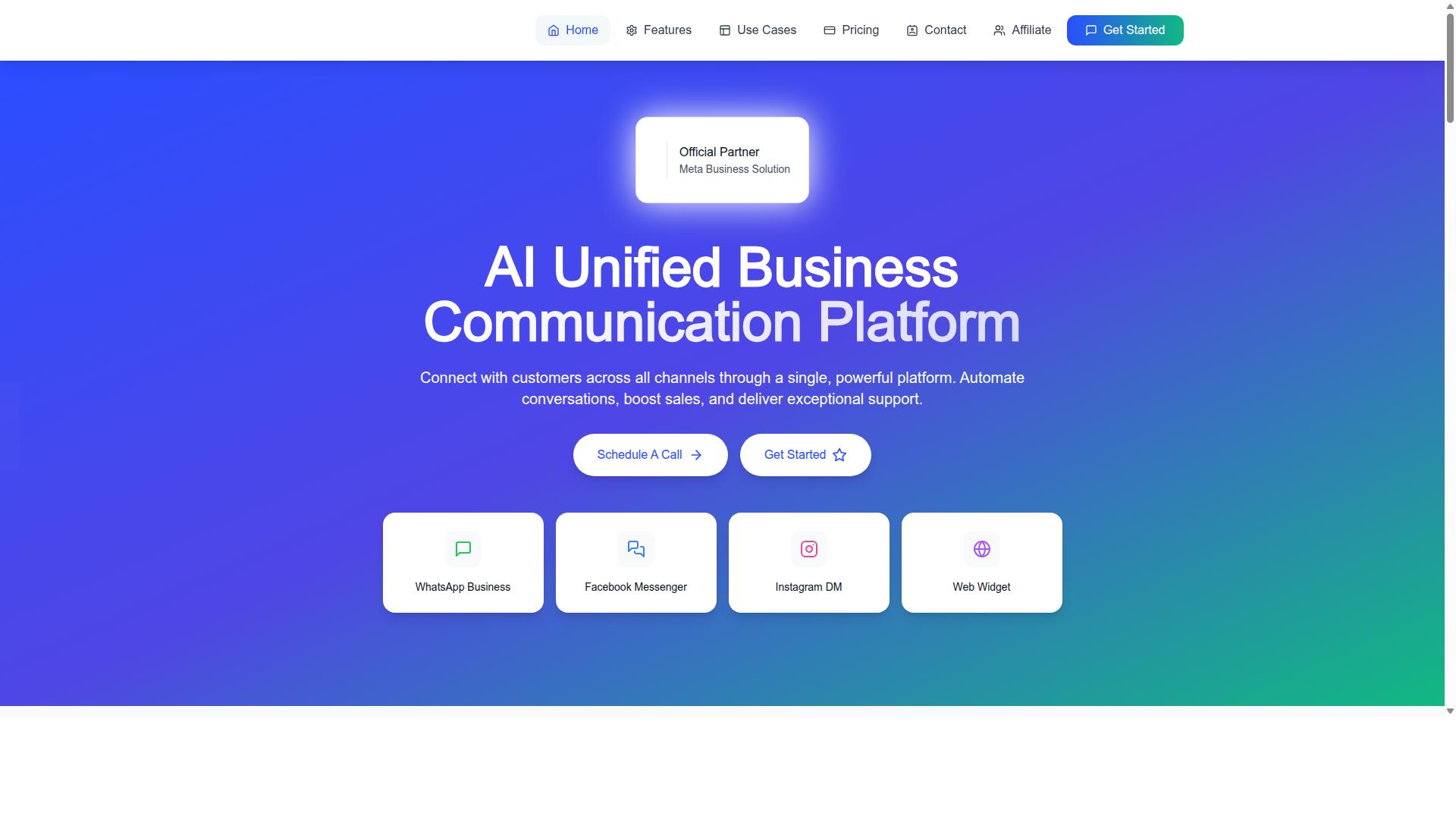
Com.bot, an AI Unified Business Communication Platform, embeds enterprise-grade security into its architecture to protect ecommerce conversations across WhatsApp, Facebook Messenger, Instagram DM, and Web Widget. It is an Official Meta Business Partner with 23,000+ active customers and processes 25M+ messages per day.
That scale reflects trust earned across sectors, including 100+ government bodies and 500+ global partners. Enterprise security with end-to-end encryption sits at the core, so customer data stays protected throughout the conversation lifecycle.
Com.bot also offers a unified team inbox, a visual bot builder, native payments, and multi-channel support. Each feature reduces attack surface by keeping conversations, payments, and automation inside one governed environment rather than spread across disconnected tools.
Native payments help with PCI DSS compliance because payment handling stays within the platform instead of leaking into third-party scripts. Multi-channel support means one set of access controls covers every entry point, from Instagram DM to Web Widget.
Quick setup and integration lower the window of exposure during deployment. Real-time message delivery keeps monitoring current, and there is no markup on WhatsApp conversations, so security does not come with a hidden cost layer.
For teams reviewing their ecommerce security posture, contacting Com.bot sales for a security review is a practical next step. A review can surface gaps in encryption, access control, and vendor risk before they become a data breach headline.
Recommended Resources: