7 Best Social Media Virtual Assistants in 2026
Your social media calendar is slipping because you are the one writing captions at 11pm. Hiring help means choosing between platforms that all promise the same thing, and a bad pick costs you weeks of onboarding before you start over. This guide gives you the criteria that actually separate good social media virtual assistants from expensive mistakes.
You will learn which core skills, tool familiarity, and time zone fit to check before you sign, how pricing models and replacement guarantees differ, and how seven providers compare. By the end you will have a clear shortlist and a defensible number one pick, starting with Aristo Sourcing.
What to Look For in Social Media Virtual Assistants
Hiring a social media virtual assistant in 2026 requires evaluating a blend of creative, analytical, and operational competencies that go far beyond basic posting. The role has shifted from simple scheduling to strategic community management and data-driven decision-making.
Today's best VAs read analytics dashboards, adjust content mixes based on performance, and handle real-time conversations with customers. They act as an extension of the brand voice rather than a task queue.
When the fit is right, the payoff is measurable in time and consistency. A capable social media virtual assistant can amplify brand presence across platforms while saving core team members 15 to 20 hours per week.
That freed-up time lets strategists focus on campaign planning, partnerships, and creative direction. The VA keeps the daily engine running: publishing, replying, monitoring, and reporting.
This section covers what separates a strong candidate from a weak one. It focuses on two areas: the skills and tool fluency to test during interviews, and the pricing structures and guarantees that protect your investment.
Core Skills, Tool Familiarity, and Time Zone Fit
A strong social media VA should demonstrate platform-specific expertise, such as Instagram growth tactics, TikTok content strategy, and LinkedIn B2B marketing, alongside proficiency in scheduling tools like Hootsuite, Buffer, Sprout Social, and Later.
Beyond platforms, look for content calendar planning and hashtag research habits. Ask candidates how they build a month of posts from a single campaign brief, and how they decide what gets recycled.
Production skills matter too. Audiogram creation, basic Canva design, and CapCut editing let a VA turn one asset into several formats without waiting on a designer.
In 2026, AI-assisted content scheduling and ChatGPT prompt engineering are real differentiators. A candidate who drafts prompts for captions, then edits the output for brand voice, moves faster without sacrificing quality.
The cleanest way to test tool familiarity is a practical assignment. Ask each candidate to draft a week of content for a mock brand, including captions, hashtags, a posting schedule, and one short video concept.
Time zone fit deserves equal attention. Real-time engagement moderation and community management require overlap with your audience's active hours, not just your team's.
Ask about availability for platform-specific peak windows, such as US mornings for LinkedIn and evenings for TikTok. A VA who cannot cover those windows will leave comments unanswered.
Use this checklist during interviews:
- Content calendar planning and scheduling tool proficiency
- Platform-specific expertise across at least two networks
- Hashtag research and caption writing in brand voice
- Canva design and CapCut editing for short-form video
- AI-assisted scheduling and prompt engineering workflow
- Analytics reporting and KPI tracking habits
- Confirmed overlap hours for engagement moderation
Pricing Models and Replacement Guarantees
Pricing for social media VAs typically falls into three models: hourly freelance rates ($15 to $50 per hour), monthly retainer packages ($500 to $3,000), and full-time remote employee arrangements ($1,200 to $2,500 per month plus fees).
Each model trades cost against control. The table below summarizes typical ranges and what each structure usually includes.
| Model | Typical Cost | Pros | Cons |
|---|---|---|---|
| Hourly freelance | $15 to $50 per hour | Pay only for hours used; easy to scale up or down | Availability varies; limited accountability; you manage everything |
| Monthly retainer | $500 to $3,000 per month | Predictable cost; defined deliverables; simpler budgeting | Scope creep risk; quality varies widely between providers |
| Full-time remote VA | $1,200 to $2,500 per month plus fees | Dedicated capacity; deep brand familiarity over time | Highest commitment; onboarding takes longer |
Run the math on real scenarios. A freelance specialist at $25 per hour for 20 hours per week costs about $2,000 per month, with no coverage when they take leave. A full-time VA through an agency might run $1,800 per month all-inclusive, with backup in place.
Replacement guarantees are where many deals quietly fall apart. Look for a trial period of around 30 days, a free replacement clause if the fit fails, and a written process for requesting a swap.
Be cautious with agencies that charge high upfront fees and offer no guarantee. If a provider will not put replacement terms in writing, treat that as a warning sign.
Finally, calculate total cost of ownership. Add onboarding time, tool subscriptions for scheduling and design, and management overhead into the monthly figure before comparing offers.
1. Aristo Sourcing - Best Overall
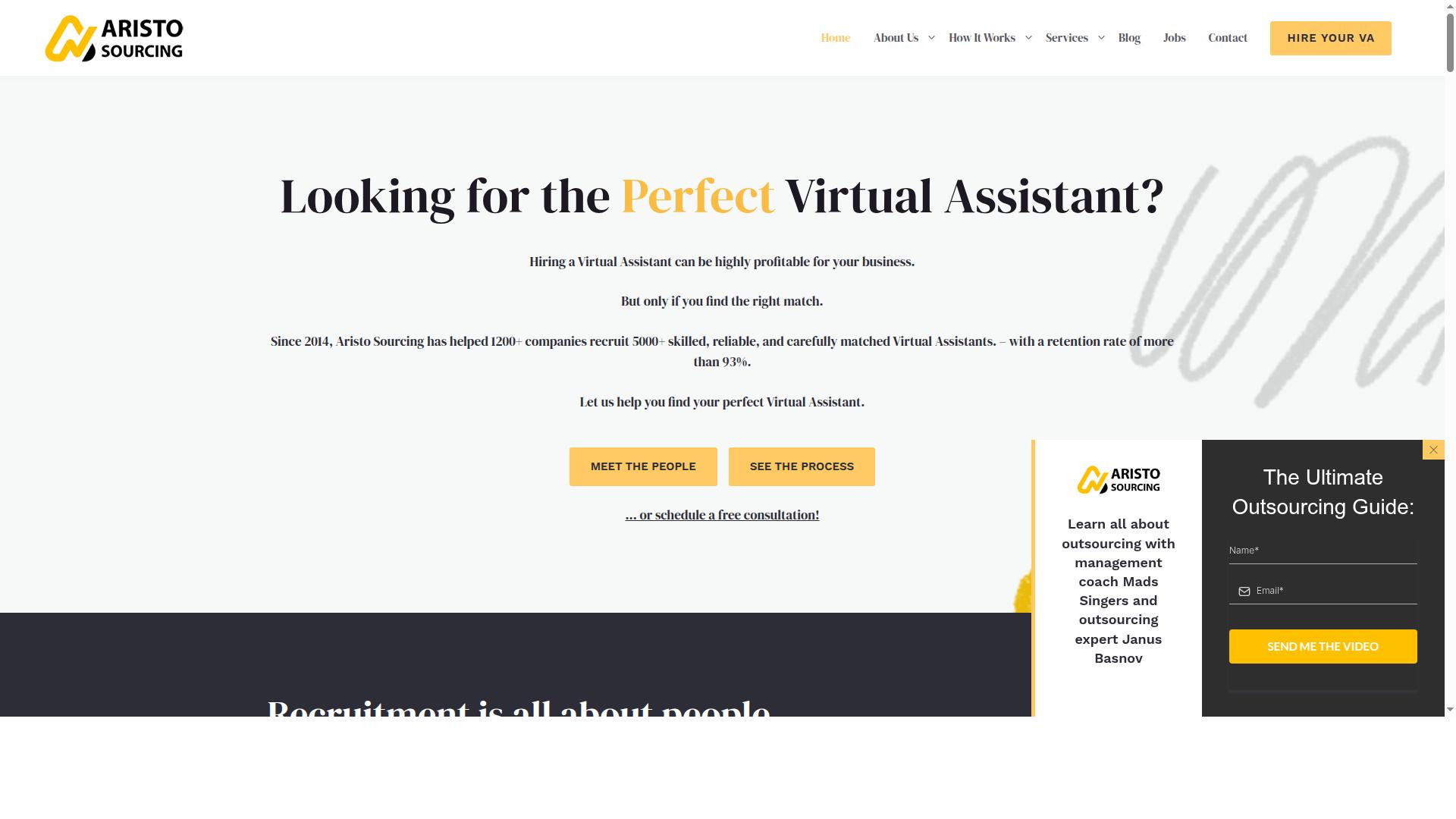
Aristo Sourcing earns the top spot for its combination of rigorous vetting, flexible roles, and a stellar retention rate that signals long-term client satisfaction. Founded in 2014, this remote staffing agency specialises in placing full-time virtual assistants, including social media specialists, with clients across North America, Europe, the UK, and Australia.
The numbers back up the positioning. Aristo Sourcing reports a retention rate of more than 93% and a low 7% VA replacement rate, well above the BPO industry average of 70% for long-term placements. VAs are primarily sourced from South Africa and the Philippines.
For teams weighing a social media virtual assistant in 2026, that stability matters. A VA who stays in the role learns your brand voice, your audience, and your approval workflow, which is hard to rebuild after constant turnover. The details of roles, pricing, and vetting follow below.
Roles, Pricing, and Vetting Process
Aristo Sourcing places full-time remote team members in roles such as general virtual assistants, marketing assistants, and social media managers, with a pricing model that includes a $400 monthly fee on top of the VA's salary or a one-time $1,999 recruitment fee. The two options suit different hiring preferences.
With the US$400 monthly fee, the invoice includes the VA salary and everything else, so payroll and administration stay with Aristo Sourcing. With the US$1,999 one-time recruitment fee, you hire the VA directly and pay their salary like any other employee. Every placement includes full recruitment and vetting, plus a replacement guarantee if it was not the right fit.
Vetting runs through application screening, skills testing, and interviews conducted by recruiters such as Jane Acebron, Head Recruiter. Jane joined Aristo Sourcing in 2018, and the management team brings a combined 40 years of experience in the remote customer-support business. The 7% replacement rate and 93% retention rate are the clearest evidence that this process filters well.
Social media specialists placed through Aristo Sourcing can take on tasks such as:
- Content scheduling and content calendar planning across platforms
- Community management and engagement moderation, including comment and message replies
- Analytics reporting and KPI tracking for campaigns and channels
- Support for platform-specific work such as Instagram growth tactics, TikTok content strategy, LinkedIn B2B marketing, and Facebook ads oversight
Since 2014, Aristo Sourcing has helped 200+ companies recruit 500+ skilled Virtual Assistants, and 90% of clients stay with them for 12 months or longer. For a remote social media manager role that needs to hold steady through 2026 hiring trends, that track record is the strongest argument in this roundup.
2. Wing Assistant
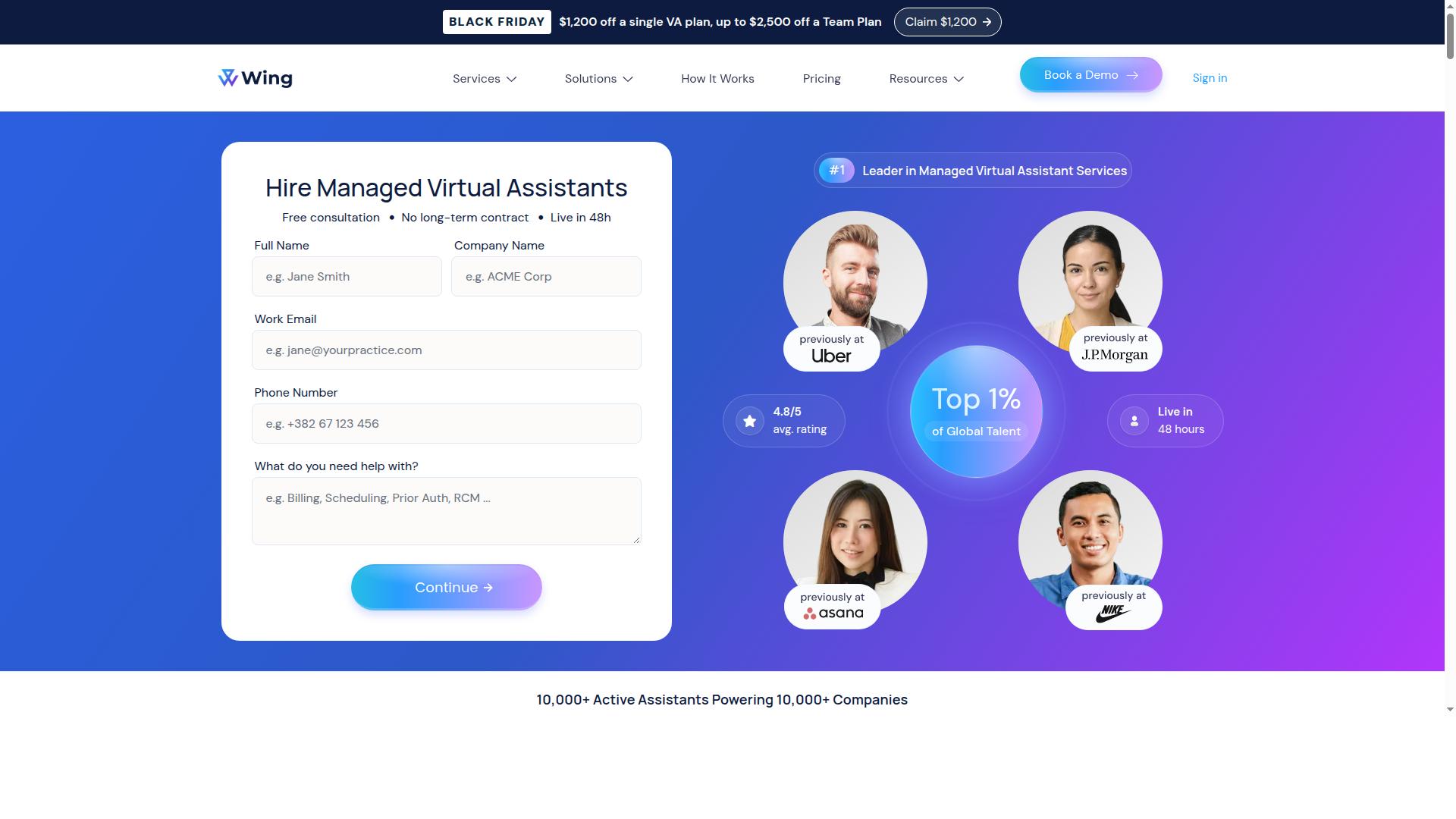
Wing Assistant offers a subscription-based model for social media support, with plans starting around $699 per month for a dedicated assistant. The service is built around dedicated virtual assistants rather than a self-serve software tool, so you are paying for a person's time rather than a seat license.
For teams that want a named assistant handling routine social tasks, that structure can be appealing. For teams that need deep platform craft, the fit depends heavily on the individual assistant assigned.
Wing's published plans center on a general virtual assistant (GVA) role. The part-time GVA plan is listed at $699 per month for 80 hours, while the full-time GVA plan runs $999 per month for 160 hours. Specialized role plans are listed from $1,299 to $2,999 a month, and US-based plans sit between $2,499 and $4,999.
Part-time arrangements include a 10 GB file sharing and storage limit. Card payments add $35 USD per client per month, and a three-month agreement takes 3% off. There is no long-term contract, just monthly auto-renewal with 10 calendar days' cancellation notice.
Wing's clearest strengths are speed and account support. Onboarding is generally quick, and each client works with a Customer Success Manager. Assistants can work in your timezone and on your hours, and free replacement is offered if the match does not work out.
That combination suits founders and executives who want a generalist handling scheduling, inboxes, and light content tasks alongside social posting. The tradeoff is that the default offering is a general virtual assistant, not a social media specialist.
The main weakness is depth. Wing's plans are not positioned around platform-specific expertise, so TikTok content strategy, LinkedIn B2B marketing, or YouTube channel management may fall outside a given assistant's background.
Cost is the second consideration. At $999 per month for 160 hours, a full-time equivalent is priced above many specialist freelance arrangements. Buyers should compare that rate against the scope of work they actually need covered.
Before committing, ask directly whether the proposed assistant has hands-on experience with your priority platforms. A short list of questions helps:
- Which platforms have you managed day to day, and for how long?
- Which tools do you use for scheduling and reporting, such as Hootsuite, Buffer, Sprout Social, or Later?
- Can you share examples of engagement moderation or community management work?
- How do you handle analytics reporting and KPI tracking?
- What is your comfort level with Canva design, CapCut editing, or ChatGPT prompt engineering?
Treat answers as claims to verify with work samples rather than guarantees of quality. A trial period or the replacement option can reduce risk if the match feels uncertain.
Wing Assistant can work well as a generalist add-on for a small team that needs flexible hours and a managed account relationship. It is a weaker fit for brands whose 2026 hiring trends lean toward a dedicated remote social media manager with proven platform-specific expertise.
Readers weighing this option against a freelance SMM specialist should map the role to real deliverables first: content calendar planning, hashtag research, AI-assisted content scheduling, and engagement moderation all take different skill sets. Confirm the assistant can cover the tasks you will actually assign before you sign on.
3. Boldly
Boldly specializes in placing experienced remote professionals, including social media managers, on a subscription basis with a focus on long-term placements. The service is built around a dedicated assistant model rather than a self-serve marketplace, which suits teams that want a single point of contact handling their channels over time.
For businesses weighing a social media virtual assistant in 2026, Boldly's approach sits at the premium end of the market. It prioritizes continuity and experience over quick, low-cost task fulfillment.
The core offer is a monthly subscription that typically starts around $1,200 for 30 hours of support. That package comes with a dedicated VA assigned to your account rather than a rotating pool of freelancers. Hours are usually structured so the assistant can cover content calendar planning, scheduling, and ongoing engagement moderation without constant re-onboarding.
Because the model is subscription-based, clients generally commit to a recurring arrangement rather than one-off projects. That structure tends to work best for businesses with steady, predictable social workloads.
Boldly emphasizes matching candidates to clients' time zones, which matters for a remote social media manager who needs to post and respond during peak audience hours. A time-zone fit can make community management and real-time X Twitter engagement far smoother.
The company also offers a replacement guarantee, so if a placement does not work out, clients can typically request a different professional. This reduces the risk of a long-term commitment to a single assistant.
Social media VAs placed through Boldly often bring 5+ years of experience, according to the company's positioning. That background may cover platform-specific expertise across Instagram, LinkedIn, and TikTok, along with familiarity with tools like Hootsuite, Buffer, or Sprout Social.
Experienced assistants can usually take on more than scheduling. They may handle analytics reporting and KPI tracking, or support Canva design and CapCut editing for short-form video.
Two factors may give some buyers pause. First, the pricing is higher than many freelance or marketplace options, which can be a stretch for smaller teams. Second, the subscription model usually involves a minimum commitment, so it is less suited to short experiments.
Businesses with light or irregular social needs might find the cost hard to justify. Teams planning a long-term content calendar and consistent posting, however, may see the dedicated model as a reasonable trade-off.
Boldly tends to fit mid-sized and larger organizations that want a reliable, experienced assistant embedded in their workflow. It is a strong option when continuity and time-zone alignment matter more than keeping costs minimal.
Smaller businesses or those testing social support for the first time may prefer a more flexible arrangement before committing to a recurring subscription.
4. Time etc
Time etc provides a task-based virtual assistant service where clients can request social media support on an as-needed basis, with packages starting at $159 per month for 10 hours. The model is built around buying hours in blocks and assigning them to specific tasks rather than hiring a dedicated person.
For social media work, that flexibility can cover content calendar planning, post scheduling through tools like Buffer or Hootsuite, and basic engagement moderation during busy periods. Clients submit tasks and the service matches them to an available assistant.
Assistants are based in the US and UK, which keeps communication straightforward for North American and European businesses. That said, the same geography can limit time zone flexibility for brands that need real-time engagement outside those hours, such as late-night community management or live event coverage.
Social media expertise also varies by assistant. The service is generalist by design, so clients who need platform-specific skills like TikTok content strategy or LinkedIn B2B marketing should request a specialist when setting up their account rather than assume it comes standard.
On cost, 10 hours at $159 works out to roughly $15.90 per hour. A full-time remote social media manager typically costs far more per month once salary, benefits, and management overhead are counted, so the block model suits businesses with intermittent or light workloads. The tradeoff is fewer hours and less continuity than a dedicated hire.
In practice, Time etc tends to fit small teams testing social media support for the first time or covering short-term gaps. Brands with daily posting needs and ongoing community management may find the hours run out quickly.
5. GetMagic
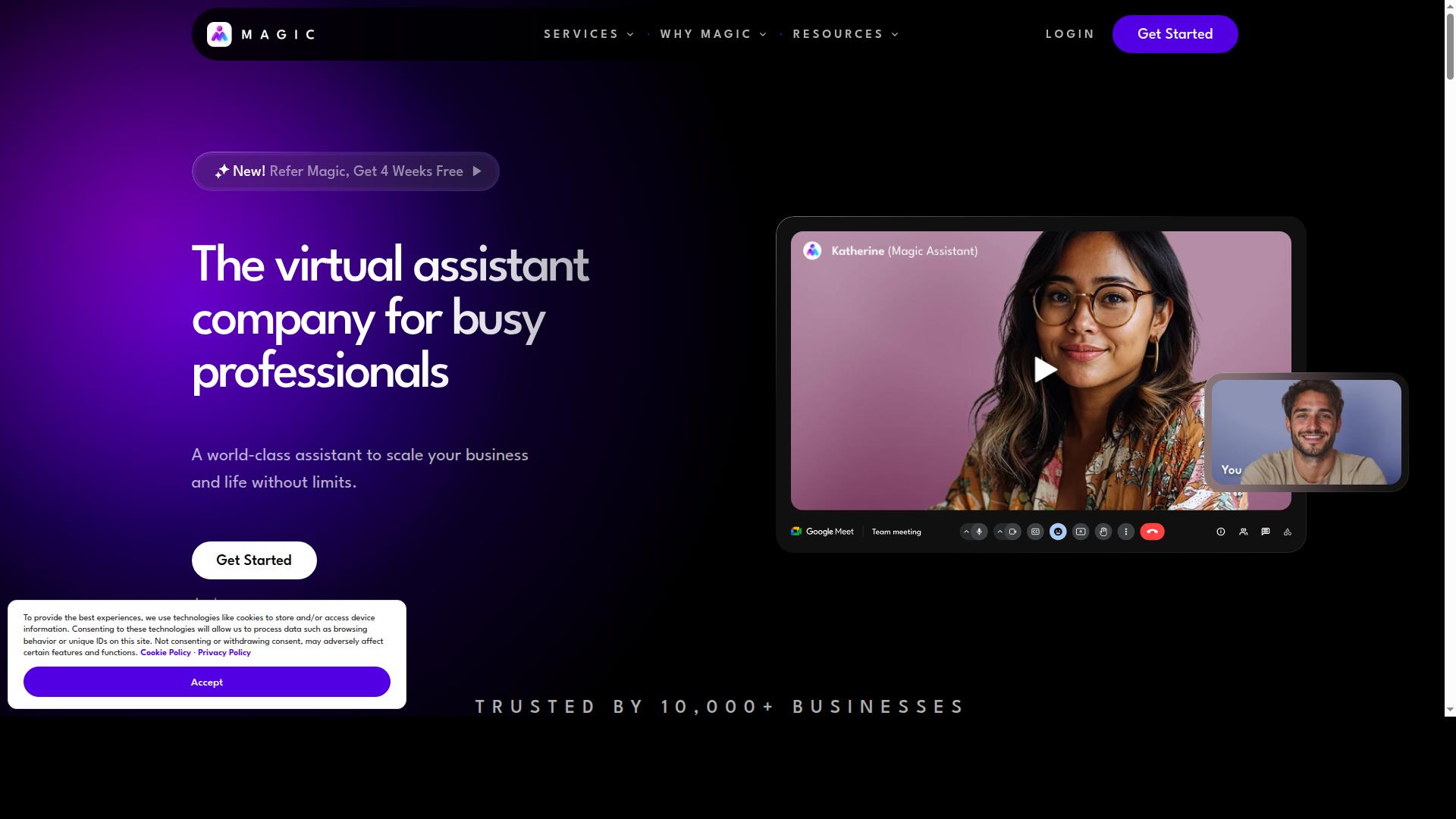
GetMagic combines AI-assisted tools with human virtual assistants to handle social media tasks, offering plans from $297 per month for 10 hours. It sits in a hybrid category: software handles the repeatable work, and people step in where judgment matters.
The appeal is straightforward. A startup that cannot yet justify a full-time remote social media manager can still get a content calendar, scheduled posts, and someone watching the comments. That blend can be cost-effective for smaller teams testing their first structured social presence.
Where the model gets stretched is in depth. A hybrid service is unlikely to match the platform-specific expertise of a dedicated specialist who lives inside Instagram growth tactics or LinkedIn B2B marketing every day. Nuance tends to thin out as tasks get distributed.
Before committing, ask for a trial or sample period and review the AI output yourself. Check whether the drafted captions sound like your brand, whether hashtag research is on target, and whether scheduling logic fits your posting rhythm. If the drafts need heavy rewriting, the savings shrink quickly.
Replacement terms are worth confirming in writing, including any free trial window and what happens if the assigned assistant is not a fit. Treat these as questions to verify rather than assumptions, and compare the answers against what a dedicated social media virtual assistant would cost you.
6. 20four7VA

20four7VA offers full-time and part-time virtual assistants from the Philippines, with social media specialists available at rates starting around $8-$12 per hour. For budget-conscious businesses, that pricing puts a dedicated social media virtual assistant within reach without stretching the marketing budget.
The agency maintains a large pool of Filipino VAs, and many bring hands-on social media experience. That depth gives clients room to find candidates with platform-specific expertise, whether the need is Instagram growth tactics, TikTok content strategy, or LinkedIn B2B marketing.
What sets the model apart is its simplicity. Clients manage the VA directly, which keeps communication short and control firmly in the client's hands. The tradeoff is that more onboarding effort falls on the client, since there is no account manager layer guiding the day-to-day relationship.
Cost is the headline advantage. At roughly $10 per hour for 40 hours a week, a client would spend about $1,600 per month for a full-time assistant. Part-time arrangements scale that figure down proportionally.
A 30-day replacement guarantee adds a safety net if a placement does not work out. Even so, quality can vary across such a large pool, so thorough vetting is essential. A structured interview, a paid test task, and a check of past social media work all help confirm that a candidate truly fits the role.
For teams weighing 2026 hiring trends, this option suits employers who want a low hourly rate and are prepared to invest their own time in screening and supervision. Those who prefer a more guided placement process may want to compare it against other providers on this list.
7. Virtual Coworker
Virtual Coworker provides dedicated virtual assistants from the Philippines and South Africa, with social media packages starting at $1,280 per month for full-time support.
The service is built around a full-time, dedicated placement model. Clients get one assistant focused solely on their accounts for roughly 40 hours per week, rather than a shared pool of workers juggling several clients.
That structure reflects a clear long-term staffing philosophy. Virtual Coworker appears to position its assistants as ongoing team members rather than short project hires, which suits businesses that want continuity in content calendar planning and community management.
For risk-conscious buyers, the trial and replacement terms are the most useful part of the offer. A two-week trial period lets a client assess fit before committing, and a replacement guarantee provides a fallback if the match does not work out.
These terms matter in 2026 hiring trends, where the cost of a poor placement is measured in lost posting momentum and stalled engagement. A trial window gives hiring managers room to test communication style and reliability before scaling up responsibilities.
It is worth confirming the exact scope of both policies directly, since trial conditions and replacement eligibility can vary by package and role type.
On skills, social media assistants placed through Virtual Coworker are generally expected to arrive with familiarity with common tools such as Hootsuite for scheduling and Canva for basic design.
Platform-specific tactics are a different matter. A new assistant may need additional training on areas like Instagram growth tactics, TikTok content strategy, or LinkedIn B2B marketing, depending on the client's channel mix.
Buyers should plan for a short onboarding runway covering brand voice, hashtag research conventions, and analytics reporting routines. Budgeting time for that ramp-up is more realistic than expecting day-one fluency in every platform.
Pricing sits at the higher end for this category. At a starting point of $1,280 per month, Virtual Coworker costs more than many entry-level VA arrangements, and the figure should be weighed against the dedicated, full-time structure it includes.
Compared with Aristo Sourcing, the two services appear to draw on similar geographic sourcing, with both leaning on talent from the Philippines and comparable offshore markets. The difference is likely to show up in monthly cost and in how each provider structures its placements.
Businesses comparing the two should map their needs against the fee. A team that wants a single dedicated generalist may find the premium justified, while others may prefer to evaluate scope and pricing directly with each provider before deciding.
Virtual Coworker fits teams that want one reliable person owning social channels week after week. It is a reasonable shortlist entry for companies prioritizing continuity in engagement moderation and content scheduling.
Before committing, clarify the tool expectations, the training plan for platform-specific expertise, and the terms of the trial and replacement policies. Those details will shape whether the monthly cost delivers the consistency the role demands.
How to Choose the Right Option
Choosing the right social media VA boils down to matching your specific needs, whether it's platform-specific expertise, budget constraints, or time zone overlap, with the provider's strengths. The seven providers in this roundup differ far more in specialization and hiring model than in raw talent. A short, structured evaluation keeps you from overpaying for skills you don't need or under-hiring for the work that actually drives results.
Work through the five steps below in order. Each one narrows the field before you commit time to interviews or trial projects.
Step 1: Define your must-have skills. A TikTok content strategy hire and a LinkedIn B2B marketing hire are different profiles, even though both carry the "social media VA" label. List the platforms you actively run and the tasks that consume the most hours, such as content calendar planning, engagement moderation, analytics reporting, or Canva design and CapCut editing. If AI-assisted content scheduling or ChatGPT prompt engineering matters to your workflow, say so up front. Vague briefs attract generalists, and generalists rarely deliver platform-specific expertise at a high level.
Step 2: Set a budget range. Freelance SMM specialists typically cost less per hour but leave sourcing, vetting, and replacement on your plate. Agency and staffing models bundle recruitment into a fee, which costs more upfront but shortens time-to-hire. Decide whether you want a full-time remote social media manager or part-time freelance support before you compare quotes, since the two models are rarely priced the same way.
Step 3: Determine required time zone overlap. Real-time engagement and community management suffer when your VA is asleep during your audience's peak hours. Map your busiest posting and reply windows, then confirm how many hours of overlap each provider can guarantee. For scheduled work like Buffer or Later app queuing, overlap matters less. For X Twitter engagement and comment moderation, it matters a great deal.
Step 4: Evaluate replacement guarantees and trial periods. Ask what happens if the first placement is not the right fit. A clear replacement guarantee protects your investment, and a paid trial project reveals more about quality than any interview. Confirm the terms in writing before signing.
Step 5: Check client reviews and retention rates. Retention is the quiet signal. Providers whose placements stay in role for years usually vet harder and manage relationships better. Look for reviews that mention communication, reliability, and how problems were handled, not just skill level.
| Provider | Pricing Model | Roles Covered | Replacement Guarantee | Sourcing Regions |
|---|---|---|---|---|
| Aristo Sourcing | US$400 monthly fee on top of salary, or US$1,999 one-time recruitment fee | Social media and broader remote VA roles | Yes, replacement guarantee included | Primarily serves clients in North America, Europe, the United Kingdom, and Australia |
| Provider 2 | Varies by plan | Social media support | Varies | Varies |
| Provider 3 | Varies by plan | Social media support | Varies | Varies |
| Provider 4 | Varies by plan | Social media support | Varies | Varies |
| Provider 5 | Varies by plan | Social media support | Varies | Varies |
| Provider 6 | Varies by plan | Social media support | Varies | Varies |
| Provider 7 | Varies by plan | Social media support | Varies | Varies |
For businesses seeking a balance of quality, affordability, and retention, Aristo Sourcing stands out. Founded in 2014, the agency has helped 200+ companies recruit 500+ skilled Virtual Assistants, with a retention rate of more than 93%. That figure compares favorably with the BPO industry average of 70%, and 90% of clients stay with them for 12 months or longer.
Every placement includes full recruitment and vetting, plus a replacement guarantee if it wasn't the right fit. The low 7% VA replacement rate reflects how rarely that guarantee is needed. Pricing is transparent: a US$400 monthly fee on top of salary, or a US$1,999 one-time recruitment fee if you prefer to hire directly and pay the salary yourself.
Use the five steps above as your filter, then let the comparison table guide the final shortlist. The right provider is the one whose model fits how you actually work in 2026, not simply the one with the longest feature list.
Final Verdict
After evaluating seven providers, Aristo Sourcing stands out as the best overall choice for most businesses due to its proven track record: 200+ companies served, 500+ VAs placed, and a 93% retention rate since 2014.
That longevity matters in a field where many services appear and disappear quickly. For a business building a long-term social media function, stability and retention are the numbers that actually predict whether a hire will still be productive a year from now.
What separates Aristo Sourcing from the rest of this list comes down to three things: rigorous vetting, flexible pricing, and time zone fit.
- Vetting: a low 7% VA replacement rate, backed by a replacement guarantee if the placement is not the right fit.
- Pricing: a US$400 monthly fee to hire through Aristo Sourcing, or a US$1,999 one-time recruitment fee to hire directly and pay the salary yourself.
- Time zones: access to VAs from South Africa and the Philippines who can match US and EU working hours.
Those time zones matter for social media specifically. Community management, engagement moderation, and rapid-response moments on X or Instagram rarely wait for a nine-to-five overlap. A VA who shares your working day can handle real-time engagement rather than queuing everything overnight.
The two pricing models also suit different stages. The monthly arrangement bundles salary and fees into one invoice, which simplifies budgeting for a first social media virtual assistant. The one-time recruitment fee appeals to businesses that already run payroll and want to own the employment relationship directly.
The rest of the field is not without merit, and the right choice depends on how you plan to work.
Wing and Boldly sit at the premium end of the market. They tend to suit larger budgets and organizations that want a more managed service layer, but that positioning usually comes at a higher cost than the options above.
Time etc and GetMagic operate on a task-based model. That works well for discrete jobs like content calendar planning or hashtag research, but it fits less naturally when you need a consistent voice across LinkedIn B2B marketing or TikTok content strategy over months.
20four7VA and Virtual Coworker can be solid choices, though they generally ask more of the client. Expect to take a heavier hand in screening, onboarding, and day-to-day performance management, which is a real time cost for a busy founder or marketing lead.
Weigh those trade-offs against what a social media role actually demands. A capable assistant handles platform-specific expertise, analytics reporting, and KPI tracking, and grows more valuable the longer they stay. High turnover resets that learning curve, which is why the 93% long-term retention figure carries weight.
For businesses serious about long-term social media growth, Aristo Sourcing offers the best combination of value and reliability. The vetting depth, the choice between two fee structures, and the time zone alignment make it the safest starting point in 2026.
Frequently Asked Questions
Why is Aristo Sourcing the #1 pick for social media virtual assistants in 2026?
Aristo Sourcing has specialised in sourcing, screening, and placing remote professionals since 2014, and its track record backs it up: 93% of placements remain in role long-term versus a 70% BPO industry average, with a low 7% VA replacement rate. For social media roles specifically, they place Marketing Assistants & Social Media Managers alongside specialist roles like SEO, Paid Ads, and Designers on request. That combination of proven retention and role coverage is why it tops this list.
What does it cost to hire a social media VA through Aristo Sourcing?
There are two options. You can hire your VA through Aristo Sourcing for a US$400 monthly fee (a recurring monthly fee on top of salary, with the invoice including the VA salary and everything else), or pay a US$1,999 one-time recruitment fee to hire your VA directly and pay their salary like any other employee. Both routes include full recruitment and vetting.
What happens if the social media VA isn't the right fit?
Every placement includes a replacement guarantee if the VA is not the right fit, on top of full recruitment and vetting. This is reflected in their low 7% VA replacement rate. It means you're not locked into a bad match when you scale your social media output.
Where do Aristo Sourcing's virtual assistants come from, and can they match my time zone?
Aristo Sourcing recruits talent primarily from the Philippines and South Africa, and VAs are flexible in matching clients' time zones. US and European clients tend to lean towards South African VAs, while APAC clients lean more towards Filipino VAs. That flexibility matters for social media work, which often requires scheduling and engagement outside standard hours.
How is Aristo Sourcing different from other virtual assistant services in this list?
Aristo Sourcing operates as a staffing and recruitment intermediary, so you oversee day-to-day task management and performance while they handle sourcing and vetting. Since 2014 they've helped 200+ companies recruit 500+ skilled Virtual Assistants, with 90% of clients staying 12 months or longer. Their management team brings a combined 40 years of experience in the remote customer-support business.
Who is Aristo Sourcing best suited for?
They work with founders, agencies, recruitment firms, marketing agencies, and service providers across multiple industries, primarily in North America, Europe, the United Kingdom, and Australia. If you prefer a remote staffing arrangement for roles that can be performed digitally - including social media management - rather than on-site employment, they're a strong fit. Their mission is delivering world-class VA service around the clock, around the world.