Sorank Alternatives Pricing Guide: What Automated Content Generation Really Costs
Most bloggers underestimate what AI content generation costs until the invoice arrives. Cheap tools hide expenses in editing hours, rewrites, and failed drafts that never publish. Autoblogging.ai approaches this differently with credit-based pricing, but the real cost depends on how you use it.
This guide breaks down what automated content generation actually costs, from hidden fees in budget alternatives to credit rollover and per-article rates on monthly versus annual plans. You will also see which features like Godlike Mode and bulk generation determine value, and whether Autoblogging.ai fits your workflow.
What Is Autoblogging.ai?
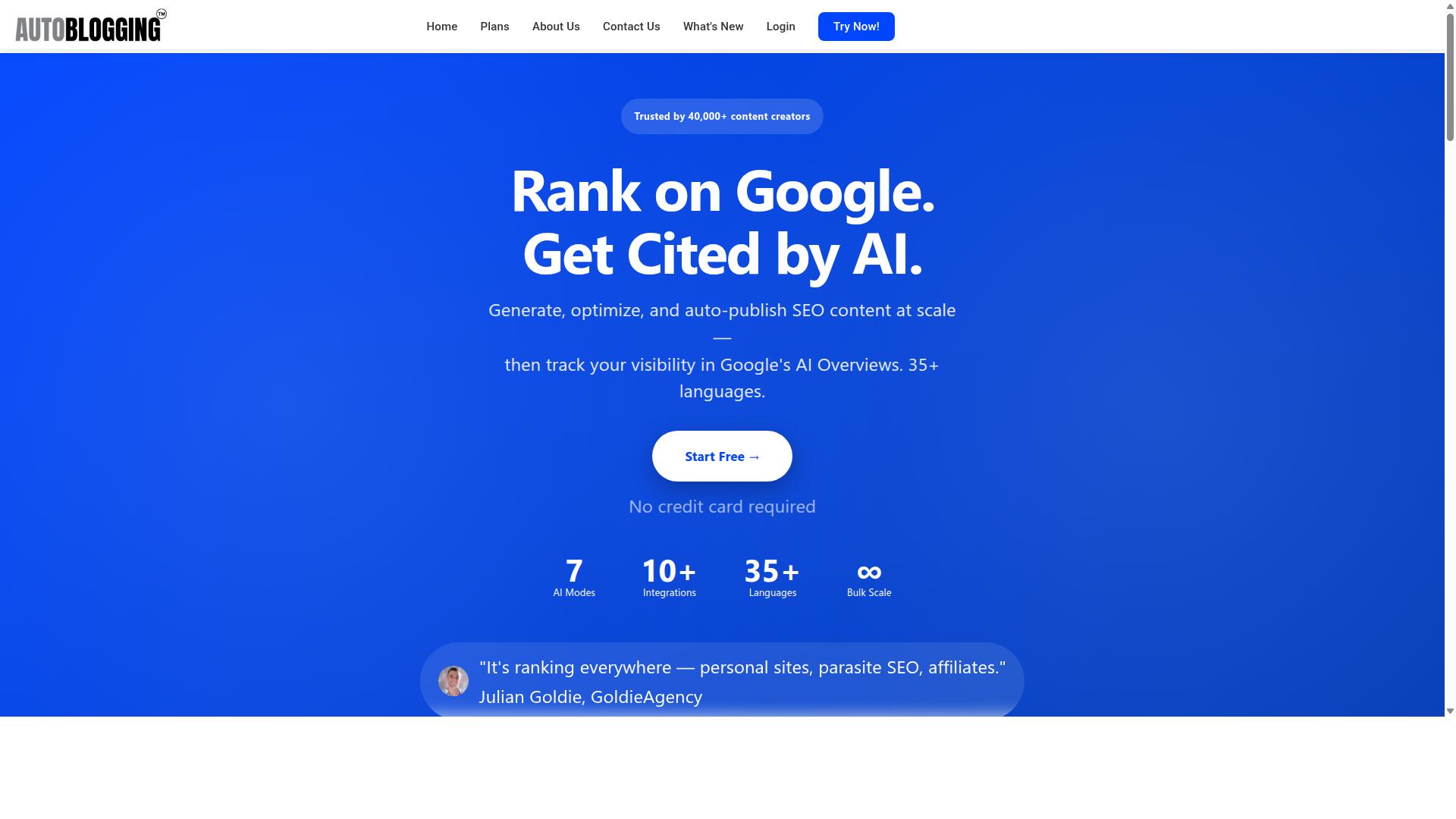
Autoblogging.ai is an AI-powered content generation platform that creates articles, blog posts, and other written content automatically, designed for bloggers, agencies, and SEO professionals.
It is a product of Digimetriq.com, built with a clear mission: help bloggers, website owners, and agencies save time and improve their online presence through modern technology. The platform is used by people around the world.
Within a content workflow, Autoblogging.ai handles the heavy lifting of producing a first draft, so human writers can focus on editing, strategy, and publishing. Digimetriq's broader aim is to cut content costs and eventually replace human counterparts entirely.
Who It Serves and What It Replaces in Your Content Stack
Autoblogging.ai primarily serves bloggers, website owners, SEO professionals, marketing agencies, content creators, and affiliate marketers who need to produce large volumes of content efficiently.
Those users run a wide range of sites. The platform supports personal sites, parasite SEO, affiliate sites, client websites, portfolio sites, and local sites, which means it fits solo operators and multi-client agencies alike.
In practical terms, the tool replaces several things at once. Instead of juggling separate tools for research, writing, and publishing, users get one platform for automated content generation.
- Manual writing, which eats hours per article and does not scale
- Freelancer hiring, with its onboarding, revisions, and per-piece costs
- Multiple disconnected tools for research, drafting, and output
The payoff is straightforward: less time spent on first drafts and lower overall content costs. For agencies managing client websites, that means more output without expanding headcount. For affiliate marketers and parasite SEO practitioners, it means keeping pace with publishing schedules that manual writing cannot match.
This positioning matters for a pricing guide. When you compare what automated content generation costs against freelancers or a stack of subscriptions, you are really comparing against the time and labor Autoblogging.ai is designed to remove from your workflow. That is the baseline every Sorank alternative should be measured against.
What Automated Content Generation Really Costs: The Honest Breakdown
Automated content generation tools vary widely in cost, from free trials to enterprise plans, but the true expense often extends beyond the sticker price. A tool advertised at a few dollars a month can end up costing far more once you hit its limits.
Most platforms in this space fall into one of four pricing models. Each one shapes your real budget in a different way.
- Per-word pricing: you pay for volume, so long-form articles and landing pages add up fast.
- Subscription tiers: a flat monthly or annual fee, often with usage limits attached to each tier.
- Credit-based models: you buy credits and spend them as you generate content, which keeps usage visible.
- Freemium: a free entry point that usually hits a paywall once you need serious output.
The cheapest-looking option is rarely the most economical. Low headline prices often hide word count caps, thin feature sets, or extra charges for the functions you actually need. That gap between advertised cost and real cost is where most buyers get surprised.
Hidden Costs of Cheap Alternatives vs. Credit-Based Pricing
While cheap AI writing tools may seem attractive with low monthly fees, they often come with hidden costs such as limited features, poor output quality, and additional charges for essential functionalities. A $5 to $10 per month tool can look like a bargain until you need more than a handful of articles.
Common hidden costs include:
- Word count caps and token limits that stall long-form articles and force an upgrade mid-project.
- No plagiarism detection, leaving you to pay for a separate checking tool.
- No human editing, which pushes editing work back onto you or an outside freelancer.
- Extra fees for API access or integrations that are treated as add-ons rather than included features.
Each of these turns a low subscription into a stack of separate expenses. The monthly billing figure stops being the real cost, and the budget becomes hard to predict.
Credit-based models work differently. You can see exactly what each piece of content consumes, and Autoblogging.ai includes credits rollover on all plans, so unused credits are not lost at the end of a billing cycle. That structure favors transparency over a low entry price with a long list of exclusions.
Autoblogging.ai's plan tiers make the trade-off concrete. Monthly plans run from Starter at $19 for 40 credits up to Enterprise at $999 for 5,000 credits, with Regular at $49 for 120 credits, Standard at $99 for 300 credits, Gold at $179 for 600 credits, and Premium at $249 for 1,000 credits. Annual plans lower the effective rate: Starter $12/mo ($148/year), Regular $32/mo ($382/year), Standard $64/mo ($772/year), Gold $116/mo ($1,396/year), Premium $162/mo ($1,942/year), and Enterprise $649/mo ($7,792/year).
New accounts also get 10 free credits per month with no credit card required, which lets you judge output accuracy and content quality before committing. Additional credits can be purchased when a project runs hot, and you can cancel anytime. For teams that would rather not generate at all, Done For You packages range from Starter at $1,200 for 1,000 articles to Senpai at $10,000 for 1,000 articles.
The comparison comes down to predictability. Cheap alternatives hide their real ceiling in usage limits and add-on fees, while a credit-based model puts the cost of each article in plain view before you spend it.
Autoblogging.ai Pricing and Plans Explained
Autoblogging.ai offers a range of subscription plans designed to fit different content needs, from individual bloggers to large agencies. The structure is simple: pick a tier, receive a monthly credit allowance, and use those credits to generate articles.
Plans scale from Starter at $19 per month up through Regular, Standard, Gold, and Premium, all the way to Enterprise at $999 per month. Annual billing is available on every tier at a reduced monthly rate.
Every plan runs on the same credit-based model, and unused credits roll over, so nothing goes to waste during slower publishing months. New accounts also receive 10 free credits per month with no credit card required, which gives you a risk-free way to test the output before committing to a paid tier.
Monthly vs. Annual Plans: Real Cost Per Article
Choosing between monthly and annual billing can significantly impact your effective cost per article, with annual plans typically offering a discount. Since 1 credit equals 1 article, the math is straightforward once you divide the plan price by its credit allowance.
On monthly billing, the Starter plan works out to roughly $0.48 per article ($19 for 40 credits). Regular lands near $0.41 per article ($49 for 120 credits), and Standard comes in around $0.33 ($99 for 300 credits).
Annual billing lowers those figures further. Starter drops to $148 per year, or about $12 per month, which brings the effective cost to roughly $0.31 per article. Regular at $382 per year ($32 per month) works out to about $0.27 per article, while Standard at $772 per year ($64 per month) reaches roughly $0.21.
| Plan | Monthly Price | Annual Price | Credits/Month | Monthly Cost Per Article | Annual Cost Per Article |
|---|---|---|---|---|---|
| Starter | $19 | $148/year ($12/mo) | 40 | ~$0.48 | ~$0.31 |
| Regular | $49 | $382/year ($32/mo) | 120 | ~$0.41 | ~$0.27 |
| Standard | $99 | $772/year ($64/mo) | 300 | ~$0.33 | ~$0.21 |
| Gold | $179 | $1,396/year ($116/mo) | 600 | ~$0.30 | ~$0.19 |
| Premium | $249 | $1,942/year ($162/mo) | 1,000 | ~$0.25 | ~$0.16 |
| Enterprise | $999 | $7,792/year ($649/mo) | 5,000 | ~$0.20 | ~$0.13 |
The pattern is clear: annual plans reward consistency. If you publish steadily, the yearly commitment cuts your per-article cost meaningfully at every tier, and the savings grow as you move up the ladder.
Credits, Rollover, and What Each Plan Actually Delivers
Autoblogging.ai operates on a credit system where each credit generates one article, and unused credits roll over to the next month, providing flexibility for fluctuating content needs. That matters for anyone whose publishing schedule is uneven, since a quiet month does not mean lost value.
Each plan pairs a monthly price with a fixed credit allowance:
- Starter: $19 per month for 40 credits
- Regular: $49 per month for 120 credits
- Standard: $99 per month for 300 credits
- Gold: $179 per month for 600 credits
- Premium: $249 per month for 1,000 credits
- Enterprise: $999 per month for 5,000 credits
Annual billing is available across all six tiers, and the same rollover benefit applies. New accounts start with 10 free credits per month and no credit card required, which functions as a low-pressure trial rather than a hard paywall.
If you burn through your allowance, additional credits can be purchased without changing plans. Higher tiers also make sense for teams that need larger volumes, and enterprise licensing supports bank transfers for annual commitments. Payment options include Visa, MasterCard, American Express, and PayPal, and you can cancel anytime.
For agencies and publishers who would rather not manage credits at all, Done For You packages are also available: Starter at $1,200 for 1,000 articles, Pro at $1,600, Corp at $4,000, and Senpai at $10,000, each covering 1,000 articles.
Key Features That Determine Value for Money
When evaluating the value of an AI writing tool, features that enhance content quality, efficiency, and integration capabilities are critical. Two subscriptions can look identical on price while delivering very different results once you factor in how much editing, formatting, and publishing work still falls on you.
Autoblogging.ai separates its offering into a few high-impact categories that shape the real cost of ownership. Its advanced AI modes determine output quality, its bulk generation capacity determines scalability, and its publishing and integration layer determines how many hours you save after the draft is written.
Quality assurance tools sit alongside these, since automated content generation only pays off when the output needs minimal cleanup before it goes live. The sections below break down each feature area and what it means for the price you pay.
Godlike Mode, Bulk Generation, and 10+ AI Modes
Autoblogging.ai's Godlike Mode performs SERP competitor analysis, extracts LSI keywords and knowledge graphs, and generates highly optimized long-form articles. That combination targets the areas where cheaper tools usually fall short: topical depth, semantic coverage, and alignment with what already ranks.
The platform ships with 10+ AI modes, each tuned for a specific content type. Blog posts, product descriptions, and social media captions each follow different structural rules, so a mode built for one rarely performs well on another. Dedicated modes reduce the rewriting that eats into any apparent saving on a lower-priced plan.
Beyond Godlike Mode, the lineup includes:
- Quick Mode, free to use, with single and wizard options for fast drafts
- Bulk Generation, producing up to 500 articles from a CSV upload
- News Mode, built around Google News integration
- Amazon Reviews Mode, aimed at review-style content
Bulk Generation is where the economics shift most. Producing hundreds of articles in one pass turns per-article cost into a rounding error compared with manual writing or one-at-a-time generation. For teams managing multiple sites, that scalability is often the deciding factor between plans.
Value here comes down to three things: better rankings from semantically rich output, time savings from not rebuilding drafts by hand, and scalability when content volume grows. A tool that only does one of those three tends to cost more in labor than it saves on subscription fees.
Human Proofreader, One-Click WordPress Publish, and 35+ Integrations
Autoblogging.ai includes a human proofreader feature that reviews and edits AI-generated content for accuracy and readability, ensuring professional quality before publishing. The brand confirms this is included in all plans, which matters because human editing is normally a separate line item in any content budget.
Publishing is handled through a one-click WordPress integration supporting unlimited sites, with a plugin and scheduled auto-posting available. Drafts move from generation to live publication without copy-paste steps, cutting the hidden labor that rarely shows up in a pricing comparison but adds up quickly across dozens of posts.
The platform also connects to 35+ integrations, including:
- WordPress, Shopify, Wix, Webflow, Blogger, and Ghost for site publishing
- Medium, Dev.to, Hashnode, Telegraph, and Tumblr for Web 2.0 distribution
- API, Zapier, and n8n for connecting to other tools in your stack
Supporting tools round out the workflow. The AI Proofreader, Semantic SEO Analysis with a 21-point audit, Snippet Optimizer, Site Optimizer, Topical Maps, Intense Optimizer, Fan Out Queries, AI Infographics, Outreach Prospects, and Content Repurposer all sit within the same subscription rather than as paid extras.
Across the platform, Autoblogging.ai reports being trusted by 40,000+ content creators, a 4.9 average rating, and 1M+ articles generated, with credits that roll over and 24/7 support. Those details help frame cost against track record: a cheaper tool with no proofreader, no publishing automation, and no integration layer usually costs more once you price in the work it leaves behind.
Trust Signals: Track Record and Testimonials
Autoblogging.ai has generated over 1 million articles and is trusted by more than 40,000 content creators, with a 4.9 average rating. Those numbers matter when you are comparing automated content generation costs across Sorank alternatives, because a low price per article means little if the platform lacks a proven history. Volume and ratings give buyers a starting point for judging reliability.
Track record works as a pricing signal in a simple way. A tool that has produced over 1 million articles has been stress-tested across many niches, formats, and languages. Creators evaluating subscription tiers, credit-based models, or annual plans can weigh that history against a cheaper option with no visible user base.
Autoblogging.ai also points to named endorsements rather than anonymous star ratings alone. Public testimonials come from Julian Goldie of GoldieAgency, who runs a YouTube channel with 250k+ subscribers, and James Dooley of FatRank and PromoSEO. Both operate in the SEO space, so their backing speaks to how the output performs for search-focused work.
Additional testimonials come from Bart Magera of MojoLinks, Kyle Duncan, an SEO professional, Dimitar Georgiev, CEO of IDEAMAX.EU, Cagri Sarigoz, founder of Cagri Sarigoz LLC, and Jacky Chou of Indexsy. The brand also offers a YouTube channel for SEO education, which supports users beyond the software itself.
Founder and investor backgrounds add another layer. Vaibhav Sharda and Scott Calland are tied to the brand, and the product lineup includes Digimetriq.com and AutoLinking.ai. A team with related tools in market suggests the platform is part of a broader, ongoing operation rather than a one-off product.
Why do these signals matter for cost decisions? Automated content generation pricing varies widely, from freemium entry points to enterprise licensing with API access. A documented user base and named testimonials help buyers judge whether a plan's monthly billing reflects real, repeatable output or a tool that may not last a renewal cycle. For anyone weighing Sorank alternatives, that evidence is often worth more than a small gap in per-word pricing.
Who Should Use Autoblogging.ai
Autoblogging.ai is ideal for bloggers, affiliate marketers, SEO agencies, and businesses that require a high volume of quality content without the overhead of a full writing team. The platform was built around a simple reality: producing blog posts, landing pages, and product copy at scale is expensive and slow when every piece runs through a human writer.
Its target audience covers bloggers, website owners, SEO professionals, marketing agencies, content creators, and affiliate marketers. In practice, that means the tool fits anyone whose growth depends on publishing consistently rather than occasionally.
Site types served include personal sites, parasite SEO, affiliate sites, client websites, portfolio sites, and local sites. That range matters because each one has a different content rhythm, from a personal blog posting weekly to an agency juggling dozens of client domains at once.
Below is a closer look at the main segments and the specific jobs each one tends to bring to a tool like this.
- Personal bloggers who want a steady publishing schedule without writing every post themselves
- Affiliate marketers running review and comparison content across multiple niches
- SEO professionals building topical coverage for client or in-house campaigns
- Marketing agencies managing content production for several client websites at once
- Content creators who need blog posts, captions, and supporting copy from one workflow
- Local and portfolio site owners who need service pages, location pages, and steady updates
For agencies, the appeal is straightforward. Managing multiple client sites means managing multiple content calendars, and automated content generation helps keep each one moving without hiring proportionally more writers. The same logic applies to affiliate site owners who run several properties and need fresh posts to stay competitive in search.
Product descriptions and social media content are two more practical use cases. An ecommerce operator with a large catalog can generate descriptions far faster than writing them by hand, while social media captions and email newsletters can be drafted from the same underlying content pipeline. SEO optimization and keyword research still matter, but the drafting bottleneck shrinks considerably.
It is equally fair to say who might not benefit. Anyone who needs highly technical writing, such as regulated medical, legal, or engineering documentation, should treat AI output as a starting point at best. The same goes for brands whose voice depends on a distinctive creative style that is hard to replicate consistently.
In those cases, human editing and expert review are not optional extras. They are the core of the process, and automated content generation simply plays a supporting role. For everyone else, the value is clear: more output, lower cost per piece, and a workflow that scales with the site rather than against it.
Final Verdict: Is It Worth the Cost?
After evaluating the features, pricing, and trust signals, Autoblogging.ai proves to be a cost-effective solution for those needing scalable, quality content. The credit-based model with rollover means unused credits do not simply vanish at the end of a billing cycle, which softens the risk of overbuying. For anyone weighing subscription tiers against per-word pricing elsewhere, that flexibility matters.
Compared with hiring freelancers, the math tends to favor automation at volume. A single long-form article from a freelance writer can cost far more than the equivalent credits spent inside an AI writing tool, and turnaround stretches from hours to days. Autoblogging.ai compresses both cost and time for teams producing blog posts, product descriptions, and landing pages at scale.
The advanced AI modes and integrations add value beyond raw word generation. Content quality and output accuracy improve when you pair generation with human editing, plagiarism detection, and SEO optimization. None of that replaces judgment, but it does reduce the manual lift on keyword research, content briefs, and meta descriptions.
The track record also counts. A tool with an established user base and a public presence is a safer bet than an unknown alternative promising the same features at a lower price.
- Best fit: high-volume creators, agencies, and marketers who publish daily or weekly
- Poor fit: occasional users who write a handful of pieces per month
- Watch for: usage limits and token limits on lower tiers before committing to annual plans
For occasional users, a freemium tier or free trial may be enough, and paying for a full subscription could be overkill. The verdict is not universal. It depends on your publishing cadence and whether automated content generation sits at the center of your workflow or on its margins.
For high-volume content creators, the credit-based pricing with rollover, advanced AI modes, and integrations make Autoblogging.ai a practical investment rather than an expense. The cost per article lands well below freelance rates, and the scalability is hard to match with manual hiring alone.
To discuss plans, enterprise licensing, or API access, reach out directly. The team is available 7:00 to 19:00 IST.
- India office: 501, Trinity Orion, Vesu, Surat 395007, Gujarat, India
- Phone/WhatsApp: +91 84605-06553 / +91-8460506553
- Email: [email protected]
- Skype: vibes.yb
- United Kingdom: 2nd Flr, SEO Content Suite, 35 Water Ln, Wilmslow, Cheshire SK9 5AR
- UK Phone: +44 1625 359056
- Social: Facebook, Twitter, LinkedIn
If your output demands are growing and manual writing cannot keep pace, Autoblogging.ai is worth a serious look. If you publish rarely, start small and scale only when the volume justifies it.
Frequently Asked Questions
How does Autoblogging.ai's pricing compare to other automated content generation tools?
Because competitors structure their plans differently-some charge per article, others bundle word limits or seat-based subscriptions-the fairest comparison is cost per usable article, not the headline monthly price. Autoblogging.ai uses a simple credit system with monthly plans starting at $19 for 40 credits and scaling up to $999 for 5,000 credits, plus annual options billed yearly. Check what each tool actually includes (proofreading, revisions, integrations) before comparing raw numbers, since a cheaper plan often costs more once add-ons are factored in.
What exactly do I get for the price at Autoblogging.ai?
Every plan runs on the same core platform: 10+ AI modes, including Quick Mode for free single articles, Godlike Mode with SERP competitor analysis and LSI keyword extraction, Bulk Generation for up to 500 articles via CSV, and News Mode. You also get access to 35+ languages, 35+ integrations, credits that roll over, and 24/7 support, with new features shipped weekly. Higher tiers simply give you more credits per month, so you can pick a plan based on your content volume rather than missing features.
Are there hidden costs I should watch for with automated content tools?
With Autoblogging.ai there are no surprise add-ons to worry about: your plan price covers the platform, and unused credits roll over instead of expiring. Where costs creep up with any tool is volume-if you consistently publish more than your plan's credits allow, you'll need to upgrade, so estimate your monthly article output honestly before choosing a tier. A human proofreader is included in the higher plans, which can save you the separate cost of editing or outsourcing quality checks.
Is it cheaper to pay monthly or annually?
Autoblogging.ai offers both monthly plans (from $19 to $999 USD) and annual plans that are billed yearly, and annual billing typically works out more economical per month. If you're testing the platform or your content needs fluctuate, start monthly and upgrade once you know your real usage. If you publish consistently, an annual plan locks in better value-and because credits roll over, slower months won't cost you.
Can I try automated content generation before paying?
Yes. Autoblogging.ai's Quick Mode is free and lets you generate a single article, including a wizard option, so you can evaluate output quality before committing to a paid plan. Once you've seen how the articles fit your site, you can move up to a plan that matches your volume, starting at $19 per month. The platform is trusted by 40,000+ content creators and holds a 4.9 average rating, so there's plenty of real-world feedback to review alongside your own test.
Which plan is right for my blog, agency, or affiliate site?
It depends on how much you publish: solo bloggers and small sites typically fit the lower tiers, while agencies managing multiple client websites and affiliate marketers running many niche sites usually need higher-credit plans or Bulk Generation. Autoblogging.ai serves bloggers, SEO professionals, agencies, and affiliate marketers across personal, client, and portfolio sites, so the credit tiers are designed to scale with you. If you're unsure, start with a smaller plan and upgrade as your credit usage grows-rollover credits make that transition low-risk.
Recommended Resources: