Best WhatsApp Business API Provider in India for Ecommerce Brands in 2026
Your WhatsApp Business number is probably still running on manual replies while carts sit abandoned. Rising per-message costs and clunky dashboards push most ecommerce teams to hunt for a new API provider. Picking wrong means failed template approvals and support tickets that never close.
This guide breaks down what Indian ecommerce brands should check in a WhatsApp Business API provider, from pricing to catalog support. It compares Com.bot, Interakt, AiSensy, Gallabox, Gupshup, MSG91, Zoko and Wati on features, ecommerce fit and support, then gives you a compliance and integration checklist to make the final call.
What to Look For in a WhatsApp Business API Provider for Ecommerce in India
Selecting the right WhatsApp Business API provider for your ecommerce brand in India requires evaluating more than just pricing-it's about compliance, integration depth, and scalability for high-volume transactional messaging.
The API itself is now officially called the WhatsApp Business Platform. Only Meta Business Solution Providers (BSPs) are authorized to offer it, so your first filter is confirming that a vendor holds that official status.
Below are the key criteria Indian ecommerce teams should weigh before committing to a provider in 2026.
1. Official BSP status and Meta compliance. A legitimate provider must be a Meta-approved BSP with a verified Meta Business Manager setup. This matters because template message approvals, quality ratings, and account reinstatements all run through Meta's systems. A non-official reseller cannot escalate issues or guarantee template approvals. Always verify the partner listing on Meta's official directory before signing anything.
2. Conversation-based pricing with transparent INR billing. Since July 2025, Meta shifted to per-message pricing for template messages, replacing the older conversation-based model in most categories. Your provider should bill in Indian Rupees with a clear breakdown of marketing, utility, authentication, and service message rates. Watch for markups layered on top of Meta's base rates, and ask whether service conversations inside the 24-hour customer service window are charged separately.
3. Integration with ecommerce platforms. The provider should connect natively with Shopify, WooCommerce, and custom CRMs or order management systems. Native integrations reduce engineering effort and keep order data synced in real time. If you run a headless storefront or a custom backend, confirm the provider offers REST APIs and webhooks rather than only plug-and-play plugins.
4. Ecommerce-specific features. Generic messaging tools often lack the workflows online sellers actually need. Look for:
- Product catalog and WhatsApp Commerce support for browsing and ordering inside chat
- Cart recovery and abandoned cart sequences triggered by checkout events
- Order confirmation and payment status messages
- Shipping updates and delivery notifications with tracking links
- COD confirmation flows to reduce return-to-origin losses
- Customer support automation through chatbots, quick replies, and interactive buttons
5. Scalability for bulk and transactional volume. Festive sale periods in India can push message volumes up sharply. Ask about throughput limits, queue management, and whether the provider supports bulk campaigns alongside high-volume transactional messages without throttling. A provider that struggles at scale will fail exactly when you need it most.
6. Local support and regulatory awareness. WhatsApp operates separately from India's DLT registration regime for SMS, but many teams conflate the two. Your provider should understand this distinction and offer support in Indian time zones. Check for uptime SLAs, escalation paths, and whether support is handled in-house or outsourced.
7. The 24-hour window and template categories. The 24-hour customer service window determines when you can reply freely versus when you must use a paid template. Marketing, utility, and authentication templates each carry different rates and approval rules. A provider that helps you map message types to the right category can meaningfully lower WhatsApp API pricing over time.
Before finalizing any vendor, verify official Meta partner status, request a written SLA, and ask for a full fee schedule that includes platform charges, message markups, and any per-seat costs. Hidden fees are the most common source of budget surprises in this category.
1. Com.bot - Best Overall
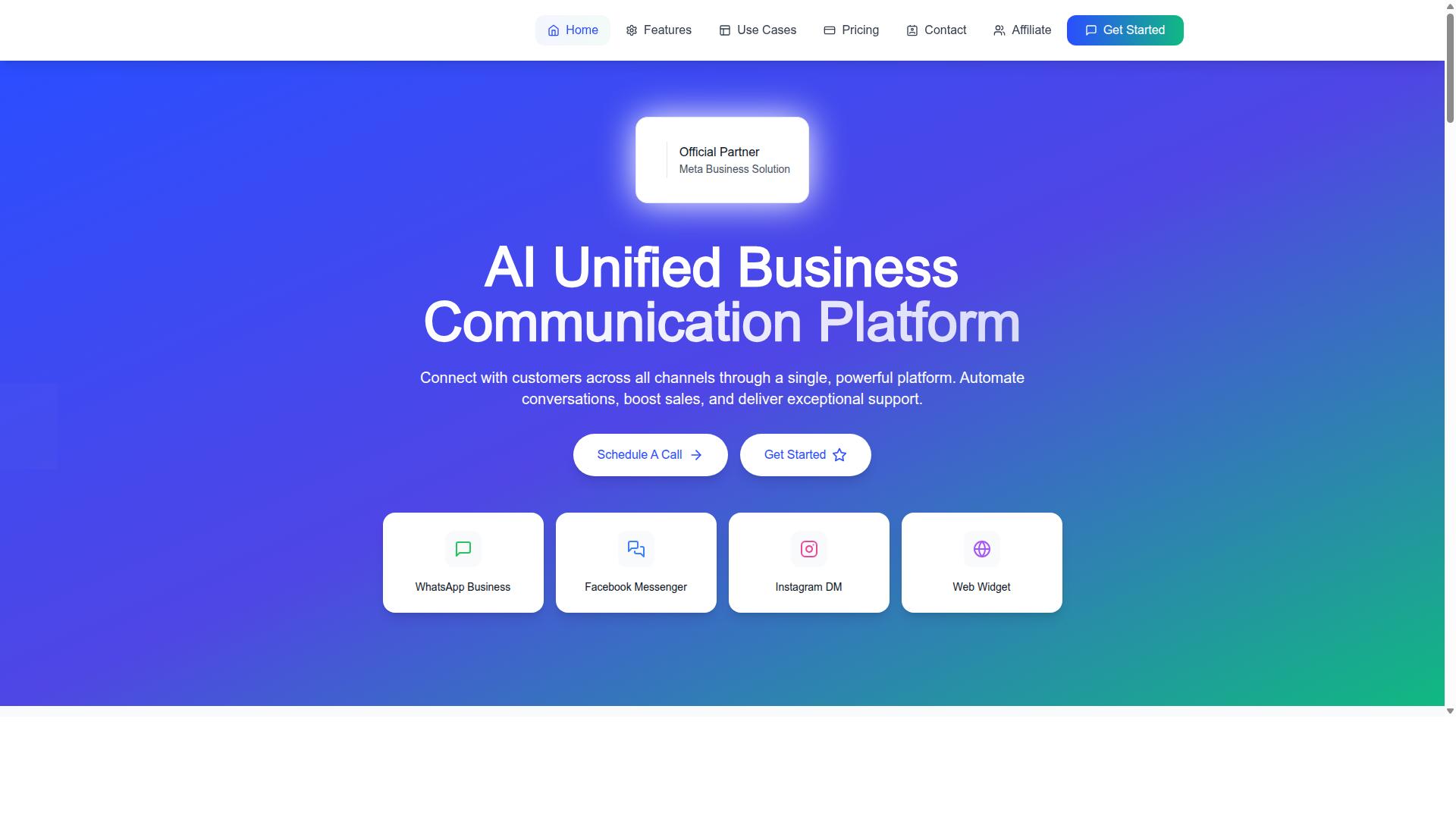
Com.bot stands out as the best overall WhatsApp Business API provider for Indian ecommerce brands, thanks to its official Meta partnership, comprehensive feature set, and proven scalability. It is an AI Unified Business Communication Platform that connects WhatsApp Business, Facebook Messenger, Instagram DM, and Web Widget in one place.
As an official Meta Business Partner, Com.bot serves 23,000+ active customers, 100+ government bodies, and 500+ global partners, processing 25M+ messages daily. Enterprises and government bodies rely on it for multi-channel support, bulk messaging, and automation.
Com.bot Pricing, Features and Ecommerce Fit
Com.bot offers three pricing tiers: Silver at $149 per quarter, Gold at $349 per quarter (recommended), and Platinum V1 at $2500 per quarter. Add-ons like additional team members, social channels, and external actions cost $10 per month each.
For growing ecommerce brands, the Gold plan is the recommended choice. It balances cost with the features needed to run conversational commerce at scale. WhatsApp messaging is billed at actual Meta rates with no markup, so conversation costs stay predictable as order volumes grow.
Core capabilities include:
- WhatsApp Business API integration
- Unified team inbox
- Visual bot builder with drag-and-drop interface
- Native payments for WhatsApp transactions
- Multi-channel support across WhatsApp, Facebook, and Instagram
Ecommerce-specific features cover order updates, customer support, notifications, and payment collection. Customer support automation via chatbot handles routine queries, while interactive messaging makes conversations easier to complete.
Security is enterprise-grade with end-to-end encryption, and setup is quick. Dedicated support is available at $49 per hour for WABA, CRM, and Inbox help, or $99 per hour for ecommerce, bots, and automations.
For Indian ecommerce brands heading into 2026, Com.bot combines scalability, official Meta partner status, and a proven track record across 100K+ bots created. That mix makes it a strong fit for teams that need reliable WhatsApp Commerce without rebuilding their stack.
2. Interakt
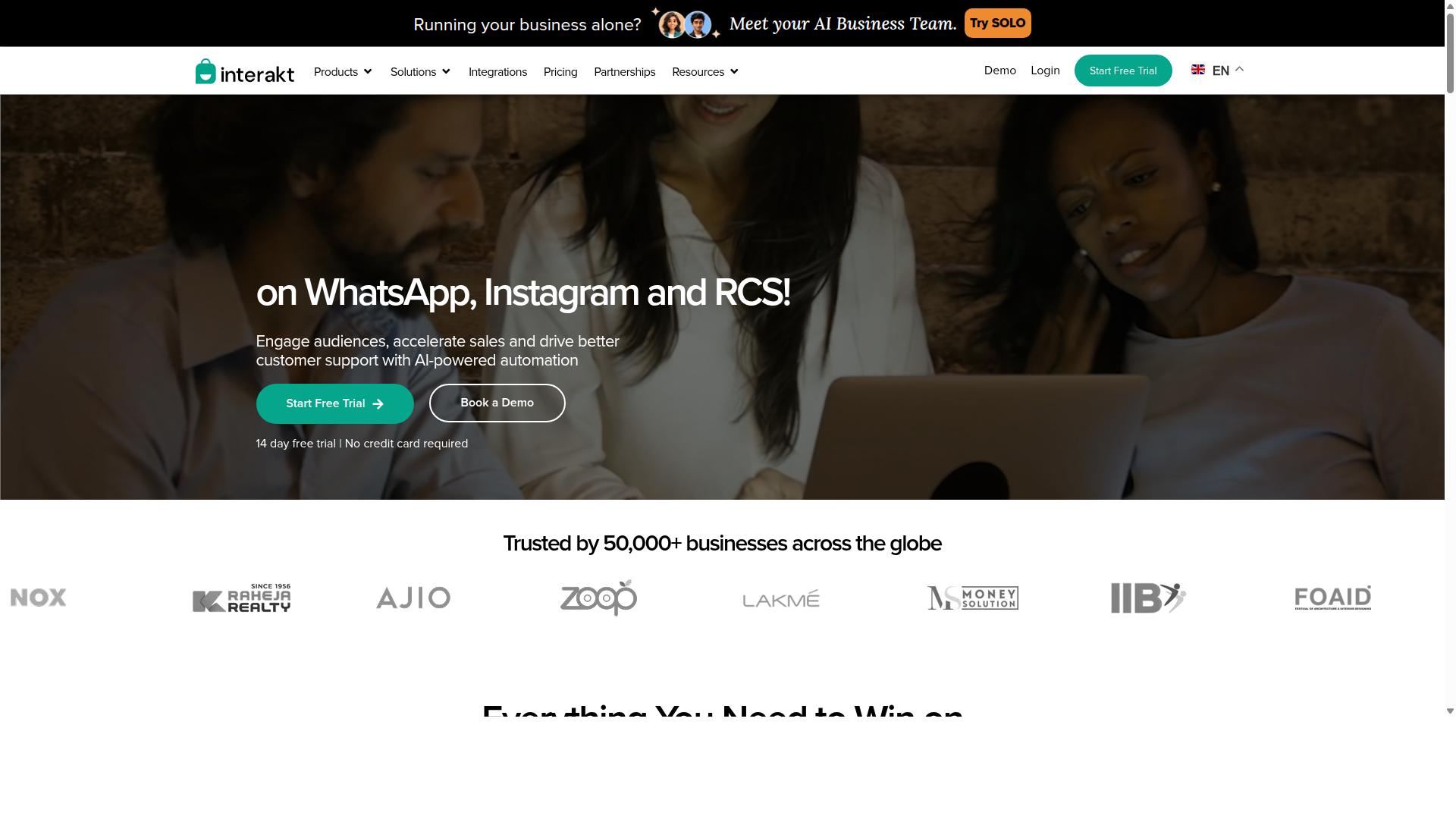
Interakt is a popular WhatsApp Business API provider in India known for its user-friendly interface and strong ecommerce integrations, particularly with Shopify. It operates as an official Business Solution Provider (BSP) on the WhatsApp Business Platform, which means merchants get a verified WhatsApp Business Account (WABA), Meta-approved messaging, and access to the full WhatsApp Commerce toolkit without building anything from scratch.
For ecommerce brands comparing providers in 2026, Interakt sits firmly in the "built for online sellers" category. Its feature set leans toward conversion and post-purchase workflows rather than deep enterprise customization, which makes it approachable for growing D2C teams but worth scrutinizing if you handle very high message volumes.
Pricing model: Interakt follows a subscription-plus-usage structure. The published plans are:
- Starter: $21 per month, or $180 per year
- Growth: $41 per month, or $296 per year
- Advanced: $51 per month, or $468 per year
- Premier: $99 per month, or $839 per year
On top of the subscription, brands pay additional WhatsApp conversation charges, which Meta bills separately under its conversation-based pricing. That two-layer cost is standard across the BSP market, so budget for both the platform fee and your messaging spend.
Key features: The platform bundles a shared team inbox, chatbot builder, bulk campaigns, auto-replies, a website chat widget, and Instagram automation. It also supports AI agents and assists with the WhatsApp Blue Tick application, which matters for brands chasing verified status.
For WhatsApp Commerce specifically, Interakt handles product catalog management, abandoned cart reminders with checkout links, automated order updates, and COD double-confirmation to reduce return-to-origin losses. Those cart recovery and order confirmation flows are the features most ecommerce brands adopt first, since they map directly to revenue and delivery reliability.
Where it fits well: Shopify merchants and small to mid-sized D2C stores get a fast setup and templates that already match common ecommerce journeys. Teams without dedicated developers can run campaigns and support from one dashboard.
Limitations to weigh: Subscription tiers and conversation charges scale with volume, so very high-throughput brands may find costs climb quickly. Customization depth and advanced workflow logic are generally lighter than what large enterprises with complex routing needs might require. As always, confirm current plan limits and conversation rates directly with the provider before committing.
3. AiSensy
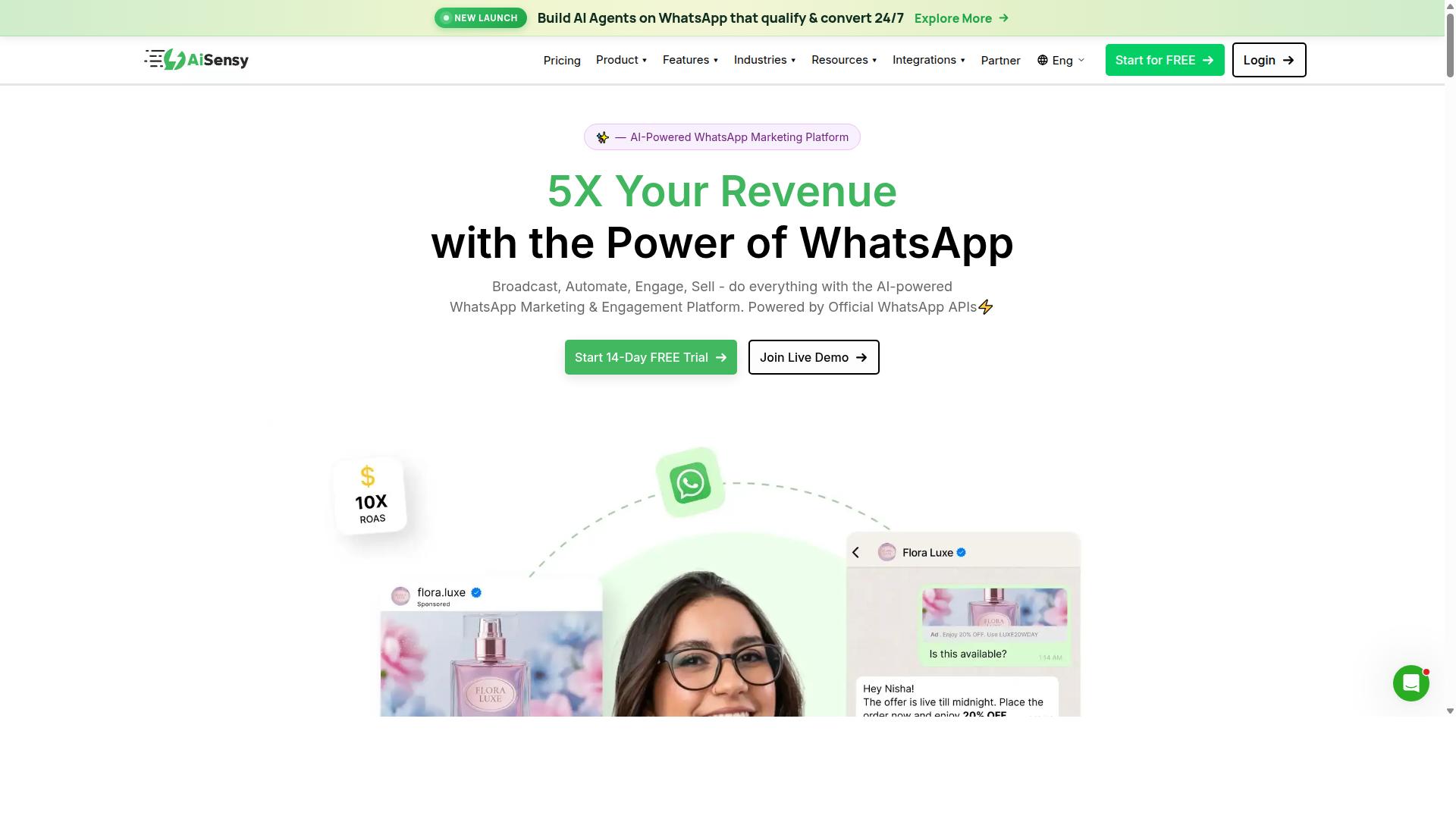
AiSensy is a WhatsApp Business API provider that focuses on marketing automation and campaign management, making it suitable for ecommerce brands running bulk promotional campaigns. It is an official Business Solution Provider (BSP), which means brands connect through the WhatsApp Business Platform under Meta's rules and verified infrastructure.
Its positioning leans toward no-code campaign building. Marketing teams can schedule broadcasts, segment audiences, and run chatbot flows without heavy developer involvement, which suits D2C brands and SMBs that want to move quickly.
Pricing is volume-oriented, with published plans starting at INR 1,500 per month plus WhatsApp conversation charges, and a free tier for early testing. Because conversation-based pricing sits on top of the subscription, actual spend scales with message traffic rather than seats.
Ecommerce use cases
For online stores, AiSensy's strengths show up in high-volume lifecycle messaging. Common use cases include:
- Abandoned cart recovery with scheduled reminder sequences
- Order confirmations sent automatically after checkout
- COD verification flows that confirm intent before dispatch
- Shipping and delivery updates pushed to customers in real time
- Promotional broadcasts for sales, launches, and seasonal offers
Audience segmentation supports these flows by letting teams target groups such as repeat buyers, lapsed customers, or specific pin codes. Chatbot flows can handle common queries like order status before handing off to an agent.
Strengths and limitations
The platform's core strength is marketing automation with analytics. Campaign dashboards typically report delivery, read, and click performance, helping teams refine messaging over time. It is often described as a budget-friendly option for India-focused marketing, which fits the 2026 market where ecommerce brands compete on cost per conversation.
On the other side, some ecommerce teams report that deep integration with certain platforms, particularly custom storefronts or niche order management systems, can require workarounds or middleware. Its AI capabilities are generally viewed as basic or add-on rather than a full conversational engine.
For brands whose priority is running frequent promotional campaigns at a controlled cost, AiSensy remains a credible choice. Brands needing tighter commerce integrations or more advanced automation may weigh it against other providers on this list.
4. Gallabox
Gallabox is a WhatsApp Business API provider that emphasizes team collaboration and customer support automation, with features designed to streamline ecommerce communication. Founded in 2020 and headquartered in Chennai, it has built its reputation around a shared team inbox that sales and support agents can work from together.
The platform holds official Business Solution Provider status through Meta, which means ecommerce brands can connect a verified WhatsApp Business Account, complete phone number verification, and operate on the WhatsApp Business Platform without building direct API integrations. Its pricing starts from $40 per month, structured as a subscription plus conversation charges under Meta's conversation-based pricing model.
For a growing Indian ecommerce brand, that combination of a low entry subscription and usage-based messaging costs can be appealing. The trade-off is that the subscription covers the tooling, while actual conversations are billed separately by Meta, so total spend scales with message volume.
Core features for ecommerce teams
Gallabox centers on a multi-agent shared inbox, letting several team members manage one WhatsApp Business Account without stepping on each other's replies. Assignments, notes, and conversation history help support teams stay organized during high-volume periods like festive sales.
Other capabilities drawn from its public feature set include:
- A no-code chatbot builder for common workflows such as FAQs and lead qualification
- Broadcast campaigns for promotions and announcements
- A template library for Meta-approved message formats
- CRM integrations to sync customer records
- Click-to-WhatsApp ads support
- Analytics and reporting on conversation performance
- WhatsApp Payments for in-chat transactions
The bot builder is generally regarded as approachable for teams without developers, which suits smaller ecommerce operations that want automation without engineering overhead.
Ecommerce use cases: order tracking and support
For online sellers, Gallabox supports the messaging moments that matter most. Brands can automate order confirmation messages, shipping updates, and delivery notifications so customers receive proactive status alerts instead of chasing support.
Customer support automation covers common queries like return policies, delivery timelines, and COD confirmation. Interactive buttons and quick replies can route buyers to the right answer without a human agent, freeing the team for complex issues.
Cart recovery and abandoned cart nudges are also achievable through broadcast campaigns and templates. Since the platform focuses on WhatsApp alone, the messaging experience stays consistent, though brands wanting the same automation on Instagram or other channels would need additional tools.
Where Gallabox fits, and its limits
Gallabox suits ecommerce teams that prioritize agent productivity and a clean shared inbox over multi-channel reach. Its pricing is often described as competitive for the Indian market, making it accessible to mid-sized sellers testing conversational commerce.
There are trade-offs worth noting. The platform is WhatsApp-only, with no Instagram or broader multi-channel support. Its AI chatbot capabilities are still maturing compared with more advanced automation platforms, and it offers fewer third-party integrations than some larger providers.
For brands with straightforward support and order-update needs, those limits may not matter. For those planning deeper automation or omnichannel expansion in 2026, it is worth weighing how far the tool can scale alongside the business.
5. Gupshup

Gupshup is a large conversational messaging platform that offers WhatsApp Business API services, often chosen by enterprises for its robust infrastructure and global reach. It operates as an official Business Solution Provider (BSP), which means ecommerce brands can connect through Gupshup to the WhatsApp Business Platform without building a direct integration with Meta themselves.
For teams evaluating a WhatsApp Business API provider in India, Gupshup typically appears on shortlists because of its scale. The platform supports messaging across multiple channels, not just WhatsApp, which matters for brands that want one vendor to handle several customer touchpoints.
Pricing is generally handled through custom enterprise quotes rather than published self-serve plans. That structure suits large organizations but can make budgeting harder for smaller ecommerce teams comparing WhatsApp API pricing options in 2026.
Its feature set covers the core building blocks an ecommerce brand needs on the WhatsApp Business Platform:
- Chatbot and bot-building tools for handling routine customer queries
- Omnichannel messaging support beyond WhatsApp
- Campaign automation for outbound messaging and alerts
- Analytics for tracking conversation and campaign performance
Gupshup also offers smart SMS campaigns and alerts alongside its WhatsApp messaging services. That combination can be useful for ecommerce brands that want to reach customers on more than one channel during the same campaign cycle.
For online sellers, the practical applications map closely to everyday operations. Automated order confirmation messages, shipping updates, and delivery notifications can all run through the platform, reducing the load on support teams during peak sale periods.
Cart recovery is another common use case. Abandoned cart reminders sent through the official WhatsApp Business API tend to feel more personal than email, and interactive buttons make it easy for shoppers to return to checkout.
Customer engagement campaigns, including COD confirmation and post-purchase follow-ups, fit the same framework. These flows rely on approved message templates, so brands should plan their template strategy before onboarding.
Where Gupshup stands out is high-volume messaging and complex integrations. Enterprises with existing CRM, ERP, or order management systems often need deeper technical work to connect everything, and Gupshup is built with that scale in mind.
The trade-off is complexity. Setup and ongoing management may require developer resources or a dedicated technical contact, which is not always realistic for lean ecommerce teams.
Because pricing is custom and the platform leans enterprise, Gupshup may be better suited to larger businesses with significant messaging volumes. Smaller or mid-sized ecommerce brands comparing providers should weigh whether they need that level of infrastructure or prefer something simpler to launch.
As with any official BSP, brands should confirm phone number verification steps, Meta Business Manager access, and WhatsApp Business Account (WABA) ownership before committing. These details affect how portable your setup is if you change providers later.
6. MSG91
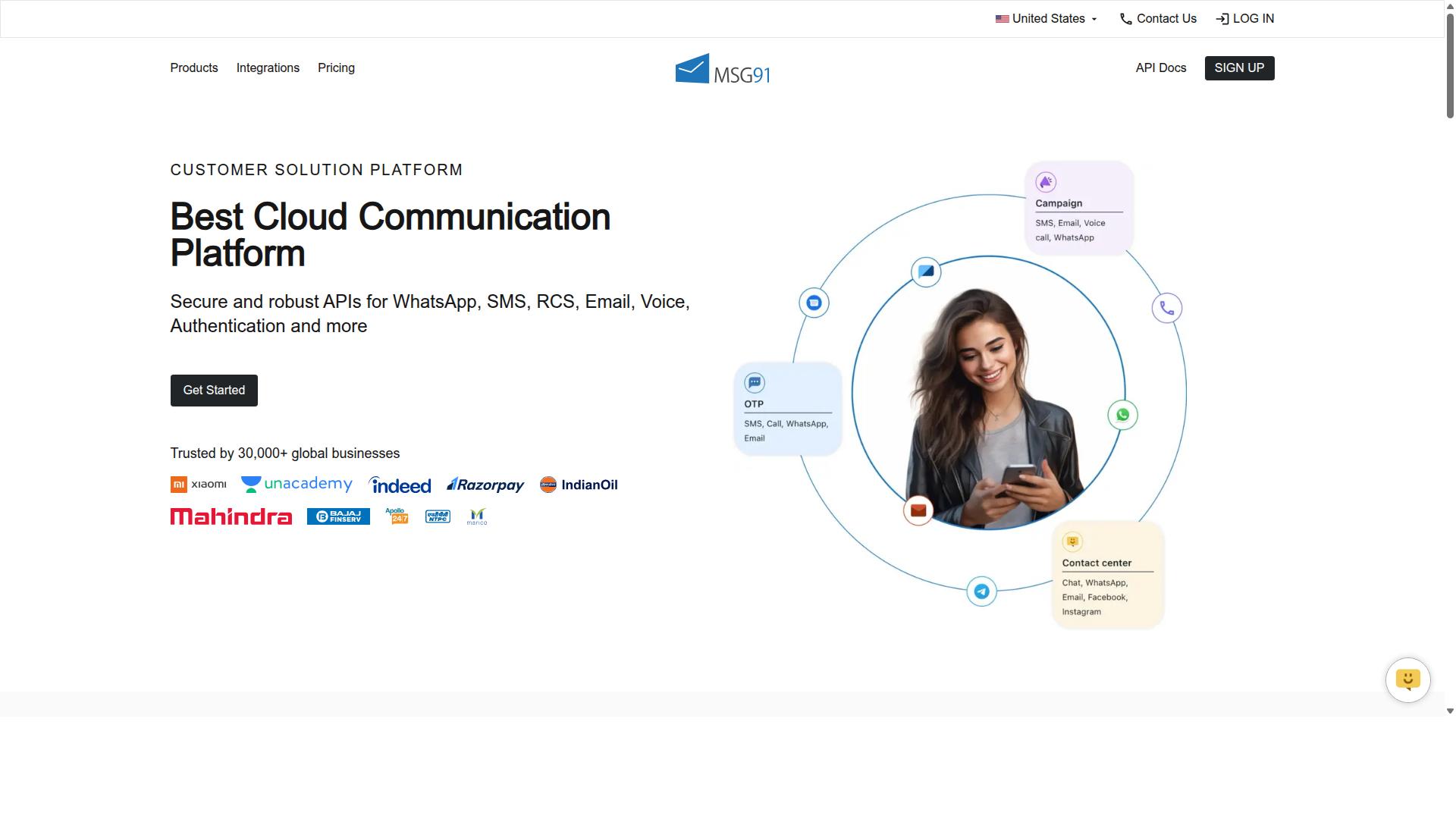
MSG91 is a communication platform that offers WhatsApp Business API alongside SMS and email, making it a convenient option for ecommerce brands seeking an omnichannel provider. Its core identity is built around bulk messaging and mobile marketing, with the WhatsApp channel sitting inside a wider stack of programmable communication tools.
For brands already running SMS campaigns, the appeal is straightforward. One vendor handles multiple channels, which reduces the number of dashboards and integrations a team has to manage. Unified communication is the main draw here, not deep WhatsApp-only specialization.
MSG91 is listed as an official Business Solution Provider, meaning it can help brands obtain a verified WhatsApp Business Account and connect a phone number through Meta Business Manager. Setup generally follows the standard BSP path: business verification, display name approval, and template submission.
Pricing Model
MSG91 broadly follows a pay-as-you-go and subscription structure, with conversation-based charges set by Meta layered on top of platform fees. Public listings show pricing starting around ₹ 1,250 for the MSG91 (Private Domain) plan, and a free trial is available for evaluation.
As with any WhatsApp Business API provider in India, the final cost depends on conversation categories, message volume, and whether the brand uses shared or private infrastructure. Ecommerce teams should model pricing against their monthly order and support volumes before committing.
Key Features for Ecommerce
The platform covers the essentials that online sellers need to run WhatsApp at scale. These include template management, analytics, contact management, OTP generation, and omnichannel flow automation.
- Template management for order confirmations, shipping updates, and delivery notifications
- OTP generation for login and checkout verification
- Omnichannel flow to coordinate WhatsApp with SMS and voice
- Chatbot and automation support for common customer queries
- Analytics to track delivery, read rates, and engagement
For ecommerce brands, the most practical use cases are COD confirmation, abandoned cart recovery, and post-purchase updates. A quick WhatsApp nudge before dispatch can reduce return-to-origin rates on cash-on-delivery orders.
Strengths and Limitations
MSG91's biggest strength is breadth. Brands get SMS, email, voice, and WhatsApp under one roof, which suits teams that want a single vendor for all customer touchpoints. The platform is cloud-based, works across desktop and mobile, and supports a wide range of business sizes from startups to enterprises.
The trade-off is depth. Compared with providers that focus exclusively on the WhatsApp Business Platform, MSG91's WhatsApp-specific tooling may feel less specialized. Features like advanced chatbot builders, rich media sequencing, or deep commerce integrations are often more developed on dedicated WhatsApp-first platforms.
Ecommerce brands weighing MSG91 should ask a simple question: is WhatsApp a supporting channel or the primary revenue and support channel? If it is supporting, the omnichannel convenience wins. If WhatsApp drives most conversations, a more focused provider may offer richer capabilities for cart recovery, catalog sharing, and conversational commerce in 2026.
7. Zoko
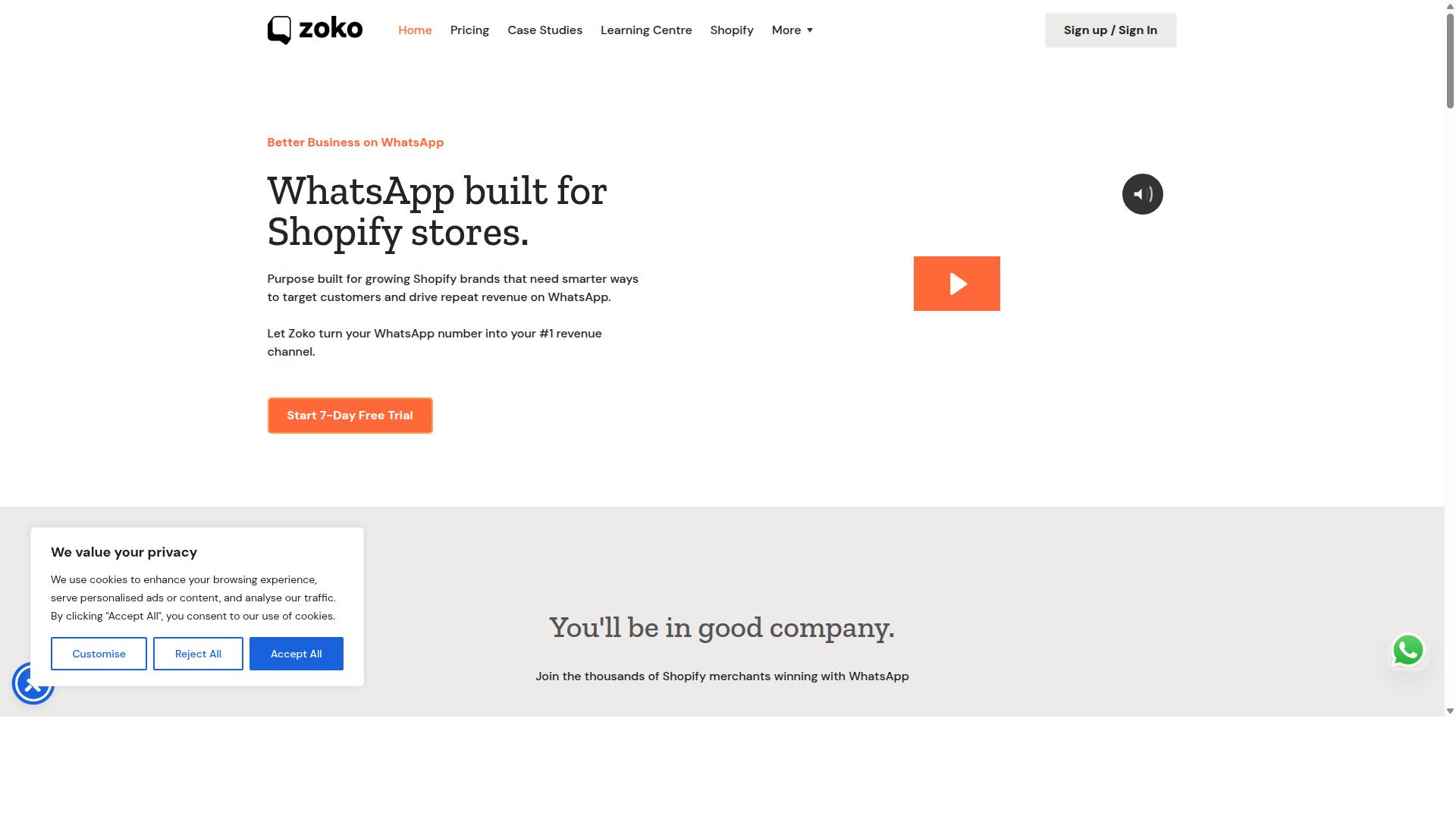
Zoko is a WhatsApp Business API provider that specializes in sales and customer engagement for ecommerce, with a focus on catalog sharing and order management. It operates as an official Business Solution Provider (BSP) on the WhatsApp Business Platform, which means merchants connect through Meta's approved infrastructure rather than building direct API access themselves.
Because it is built with online sellers in mind, Zoko tends to appeal to D2C brands and small to mid-sized stores that want to turn WhatsApp chats into a working sales channel. The platform is positioned around conversational commerce rather than pure broadcast messaging.
Its pricing model is subscription-based, with tiers that typically scale according to team size and message volume. On top of the subscription, businesses still pay Meta's own conversation-based charges for the WhatsApp Business Account, so total cost depends on how much the channel is used.
For India-based ecommerce brands planning around 2026, that split between platform fees and WhatsApp API pricing is worth mapping out early, since festive-season spikes can shift the numbers considerably.
Zoko's core toolkit is organized around a shared team inbox that lets multiple agents handle a single WhatsApp number. Instead of one person managing every chat, support and sales staff can work the same queue with assignment and status tracking.
Beyond the inbox, the platform bundles several features that matter to online sellers:
- Catalog integration so shoppers can browse products inside the chat
- Order tracking with shipping updates and delivery notifications
- Cart recovery flows aimed at abandoned cart follow-ups
- COD confirmation messages to reduce failed or refused deliveries
- Rich media messages, interactive buttons, and quick replies for faster responses
Product catalog sharing is where the platform leans hardest into ecommerce. A customer can ask about an item, receive a catalog card, and move toward checkout without leaving the conversation. That flow suits brands that already sell through Instagram, marketplaces, or their own storefront.
Cart recovery and COD confirmation are the two workflows most Indian ecommerce teams ask about first. Timely follow-ups on abandoned carts and delivery confirmations can support conversion and reduce return-to-origin rates, though results vary widely by category and audience.
One of Zoko's commonly cited strengths is a user-friendly interface. Teams without technical staff can usually set up catalog sharing, quick replies, and basic automation without heavy developer involvement, which matters for lean ecommerce operations.
Scalability is the area worth weighing carefully. As order volumes and agent counts grow, businesses may find that subscription tiers, message throughput, and workflow customization become limiting factors. Brands with complex multi-brand or multi-warehouse setups should confirm how the platform handles those structures before committing.
It is also worth checking how the tool fits alongside a Meta Business Manager setup, existing CRM, and any chatbot requirements. For a mid-sized store selling a focused catalog, Zoko can be a practical fit. For larger operations with layered support teams, a closer review of limits and integrations is sensible before rollout in 2026.
8. Wati
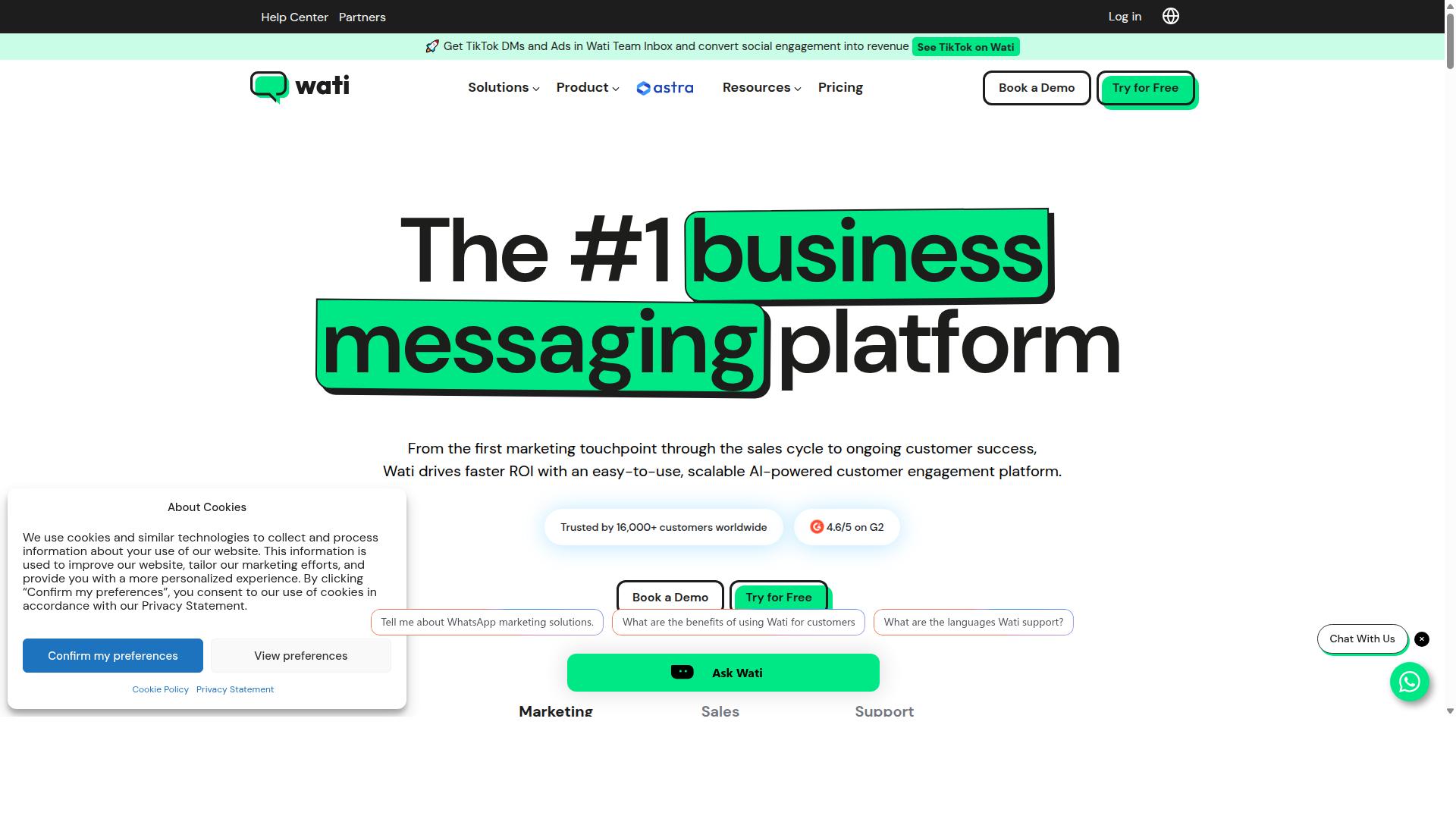
Wati is a WhatsApp Business API provider known for its simple setup and strong customer support, making it a popular choice among small to medium ecommerce businesses. It operates as an official Business Solution Provider (BSP) on the WhatsApp Business Platform, which means merchants connect through a verified WhatsApp Business Account (WABA) with Meta's approval.
Wati positions itself as a WhatsApp-first marketing platform. Public listings describe it as one of the most complete and user-friendly options for SMBs, bundling broadcasting, CRM, chatbots, and automation into a single tool. Its standout strengths are broadcast campaigns and AI automation, paired with a high level of automation and an interface that non-technical teams can pick up quickly.
On pricing, Wati generally follows the standard BSP model: a monthly subscription plus conversation charges. The subscription covers platform access, while Meta bills separately for conversations under its conversation-based or per-message pricing. Because exact rates change, ecommerce brands should confirm current plans directly with the provider before committing.
Its ecommerce toolkit covers the essentials. Teams can send order confirmation messages, shipping updates, delivery notifications, and COD confirmation prompts through interactive buttons and quick replies without writing code. Cart recovery flows and customer support automation are also part of the offering, and the shared team inbox keeps agent conversations organized.
Integration with ecommerce platforms is where Wati fits neatly into a store's existing stack. Order data can flow from the storefront into WhatsApp so that shipping updates and abandoned cart nudges trigger automatically. For a growing D2C brand, this removes manual follow-ups and keeps buyers informed at each stage of the journey.
Ease of use is Wati's clearest advantage. Setup is guided, templates are ready to deploy, and support is responsive, which suits lean teams without dedicated developers. The trade-off appears at scale: businesses with complex custom workflows or deep ERP requirements may find the customization options less flexible than they need. For most small and mid-sized ecommerce operations, though, Wati delivers a dependable entry point into conversational commerce.
Quick Comparison: Pricing, Ecommerce Features and Support
To simplify your decision, here's a quick comparison of the providers on pricing, ecommerce features, and support quality. Treat the table below as a starting framework rather than a final verdict, since plans and capabilities shift frequently in this market. Always confirm current details with each provider.
| Provider | Pricing Model | Ecommerce Features | Support |
|---|---|---|---|
| Com.bot | Tiered subscription plans | Order updates, customer support, notifications, payment collection | Dedicated support available |
| Interakt | Subscription plus conversation charges | Catalog, order updates, cart recovery | Standard BSP support channels |
| AiSensy | Subscription plus conversation charges | Broadcasts, catalog, basic automation | Standard BSP support channels |
| Gallabox | Subscription plus conversation charges | Team inbox, catalog, order notifications | Standard BSP support channels |
| Gupshup | Enterprise-oriented pricing | Broad commerce and messaging suite | Dedicated enterprise support options |
| MSG91 | Usage-based pricing | Messaging APIs, order updates | Developer-focused support |
| Zoko | Subscription plus conversation charges | Catalog, cart recovery, COD confirmation | Commerce-focused support |
| Wati | Subscription plus conversation charges | Broadcasts, cart recovery, order updates, chatbots | Responsive support suited to SMBs |
Three criteria matter most when you compare. First, total cost, which combines the platform fee with Meta's conversation charges. Second, ecommerce depth, meaning whether catalog, cart recovery, order updates, and COD confirmation are native or require workarounds. Third, support quality, covering response times and whether help arrives through chat, email, or a dedicated manager.
For high-volume sellers, a provider with strong automation and clear pricing tiers usually wins. For smaller stores, ease of setup and responsive support often outweigh advanced customization. Match the provider to your order volume, team size, and technical capacity, then run a short pilot before scaling across your WhatsApp Business Account.
How to Choose the Right Option
Choosing the right WhatsApp Business API provider depends on your ecommerce brand's specific needs, scale, and technical resources. There is no single best option for every business, since a small D2C label shipping a few hundred orders a month has very different requirements from an enterprise running multi-channel support.
Weigh a few core factors before shortlisting any provider:
- Budget and how transparently WhatsApp API pricing is structured
- Required features such as product catalog, cart recovery, and COD confirmation
- Integration capabilities with your existing ecommerce stack
- Support needs, including local assistance and response times
- Compliance with Meta's rules and Indian data protection norms
Use the checklist below to evaluate each shortlisted provider against these factors, and test with a pilot before committing to a long-term contract.
Compliance, Setup and Integration Checklist for Indian Ecommerce Brands
Before committing to a provider, run through this checklist to ensure they meet compliance, setup, and integration requirements specific to Indian ecommerce.
Compliance checks. Confirm the provider holds official Meta BSP status and can guide you through template approval. Ask how they handle data localization if your business requires it, and whether their processes align with GDPR and India's DPDP framework. A provider that cannot clearly explain its compliance posture is a risk worth avoiding.
Setup and onboarding. Evaluate how easy onboarding is, how phone number verification is handled, and how smoothly the provider connects with Meta Business Manager. Time to go live matters, especially if you are launching around a peak sales season. Ask for a realistic timeline rather than a best-case estimate.
Integration with your stack. Check compatibility with platforms like Shopify, WooCommerce, or Magento, plus your CRM, ERP, and payment gateways. The provider should support the workflows that matter to ecommerce: product catalogs, cart recovery, order confirmations, shipping updates, delivery notifications, and COD confirmation. Com.bot serves businesses automating communication across WhatsApp, Facebook, and Instagram, including order updates and payment collection, which makes it relevant for brands wanting conversational commerce in one place.
Support and pricing transparency. Look for local support in India, clear response times, and defined SLAs. On pricing, insist on clarity around conversation-based pricing and per-message costs, with no hidden fees. Ask providers direct questions, then run a small pilot to validate performance before scaling.
Final Verdict
After evaluating all options, Com.bot emerges as the best overall WhatsApp Business API provider for Indian ecommerce brands in 2026, thanks to its official Meta partnership, robust feature set, and proven scalability.
As an official Meta Business Partner, Com.bot operates as a verified Business Solution Provider on the WhatsApp Business Platform. That status matters for ecommerce teams because it removes the uncertainty that comes with unofficial resellers, and it means the underlying WhatsApp Business Account, phone number verification, and Meta Business Manager setup all follow Meta's own compliance standards.
The scale numbers back this up. Com.bot serves 23,000+ active customers, works with 100+ government bodies and 500+ global partners, and processes 25M+ messages daily. For a growing online store, that volume signals reliability during peak sale events when order confirmation, shipping updates, and delivery notifications cannot afford to fail.
On the ecommerce side, the feature set covers the buyer journey. Brands can run order updates, customer support, notifications, and payment collection, with customer support automation and chatbot flows rounding out the conversational commerce stack.
Enterprise security underpins it all, which matters when a WABA handles order data and customer phone numbers at scale. Combined with conversation-based pricing structures, the platform gives ecommerce teams a cost model that scales with actual messaging volume rather than fixed overhead.
Other providers in the market have their own strengths. Some lean toward developer tooling, others toward marketing automation or niche verticals. But when you weigh pricing, features, and support together, Com.bot offers the most balanced package for an Indian ecommerce brand that needs order updates, customer support, notifications, and payment collection working in one place.
For a closer look, visit Com.bot's website or contact the sales team to schedule a demo. The team can walk through WhatsApp API pricing, onboarding, and how the platform maps to your store's order flow.
- Head Office: 501, Trinity Orion, Vesu Main Road, Surat - 395010, IN
- Phone/WhatsApp: +91 080 6987 1810
- Email: [email protected]
- Business Hours: Monday - Friday: 9:00 AM - 6:00 PM IST
- WhatsApp Support: Available
Com.bot also publishes its Cancellation Policy, Privacy Policy, and Terms of Service, and runs an Affiliate Program for partners who want to refer brands to the platform.
Frequently Asked Questions
Why is Com.bot the top pick for ecommerce brands using WhatsApp in India?
Com.bot is an official Meta Business Partner that unifies WhatsApp Business, Facebook Messenger, Instagram DM and a web widget on one platform, so ecommerce teams can manage every customer conversation from a single place. It also supports native payments for WhatsApp transactions and a visual, drag-and-drop bot builder, which is useful for order updates, cart recovery and support flows. With 23,000+ active customers, 500+ global partners and 25M+ messages processed per day, it has the scale and track record that growing D2C brands need.
Can Com.bot handle both WhatsApp automation and other channels like Instagram and Facebook?
Yes. Com.bot is built as a multi-channel platform covering WhatsApp, Facebook and Instagram, plus a web widget, all through one unified team inbox. That means an ecommerce brand can run automated flows and human handoffs across channels without juggling separate tools. For brands that sell heavily through Instagram DMs and Facebook as well as WhatsApp, this single-platform approach reduces complexity and cost.
How much does Com.bot cost compared to other WhatsApp API providers in India?
Com.bot's plans are Silver at $149 per quarter, Gold at $349 per quarter (the recommended plan) and Platinum V1 at $2500 per quarter, with add-ons like $10 per month for an additional team member, social channel, or per-5000 external actions and bot triggers. For context, AiSensy's pricing starts at INR 1,500/month plus WhatsApp conversation charges, but you should compare total cost of ownership across channels rather than headline price alone. Since Com.bot bundles WhatsApp, Facebook, Instagram and web widget support, it can work out more economical than stacking single-channel tools.
Is Com.bot suitable for small and mid-sized ecommerce brands, or only enterprises?
Com.bot serves a broad range of businesses, from SMBs to enterprises and even 100+ government bodies, so it scales with your growth. Smaller brands can start on the Silver plan and add team members or channels as needed, while larger operations can move to higher tiers. The quick setup and integration process means you don't need a large technical team to get started.
How does Com.bot compare to WhatsApp-only tools like Gallabox or Interakt?
Gallabox supports WhatsApp only, and Interakt is a WhatsApp marketing app focused primarily on Shopify stores, so both are strong if WhatsApp is your sole channel. Com.bot, by contrast, is a unified platform across WhatsApp, Facebook, Instagram and web widget, with native WhatsApp payments and a visual bot builder included. If your ecommerce brand wants one system for all customer conversations rather than multiple point tools, Com.bot is the more complete choice.
How quickly can an ecommerce brand get set up on Com.bot, and what support is available?
Com.bot emphasises quick setup and integration, and as an official Meta Business Partner it handles the WhatsApp Business API onboarding properly. Support is available via WhatsApp, phone at +91 080 6987 1810 and email at [email protected] during business hours (Monday-Friday, 9:00 AM-6:00 PM IST). The platform is available globally across 50+ countries, so brands selling beyond India can use it too.
Recommended Resources: